Though DNA evidence is often considered the “gold standard,” records show other forms of evidence result in slightly more murder convictions.
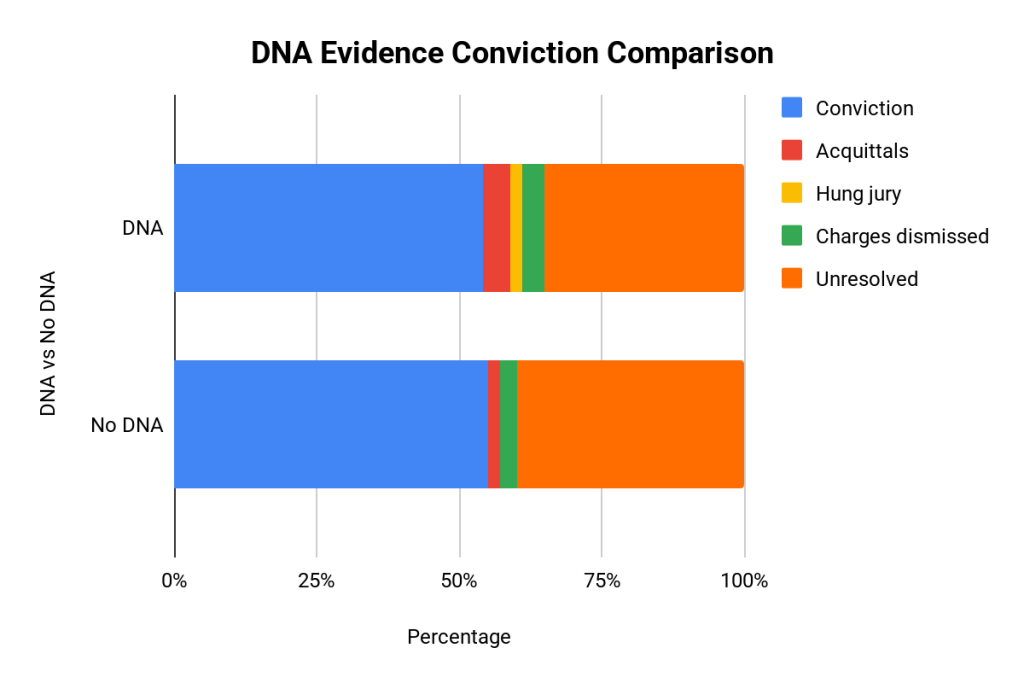
D.C. Witness reviewed 165 homicide cases from November 2023 to March 2026 involving recovered DNA, a substance which can be linked with mathematical precision to a defendant’s biological make up. In the 57 cases where DNA was a factor, the conviction rate was slightly lower compared to verdicts rendered through other forms of evidence.
Consider Julian Ruffin’s case. He was accused of fatally stabbing a 38-year old man in October of 2022. As the trial proceeded the prosecutor introduced a bloody knife and blood-stained T-shirt recovered from a search warrant of Ruffin’s apartment. That evidence investigators say not only contained DNA linked to the victim but Ruffin’s as well.
Ruffin’s attorney, Kevin Irving, countered that since the two men were engaged in an argument prior to the murder, blood and spit containing DNA could easily have been transferred to the evidence unrelated to the crime.
Irving’s argument convinced the jury to acquit Ruffin in April of 2025, despite the DNA evidence, on the grounds of self-defense
165 Homicide Cases From 2023 to 2026 With and Without DNA Evidence
| DNA vs No DNA | Total Case | Conviction | Acquittals | Hung Jury | Charges dismissed | Unresolved |
| No DNA | 65% (108) | 55% (60) | 2% (2) | 0% (0) | 3% (3) | 40% (43) |
| DNA | 35% (57) | 54% (31) | 5% (3) | 2% (1) | 4% (2) | 35% (20) |
Daniele Podini, Ph.D, is an associate professor at George Washington University who specializes in DNA technology. He calls DNA evidence “very compelling,” given that it is both sensitive and highly precise.
We all share 99 percent of the same DNA, but one-tenth of the molecule is unique and determines core inherited characteristics like hair, skin, blood or saliva.
While fingerprints are distinctive, they may degrade over time. During proceedings bullet fragments, social media posts, phone records, surveillance footage and particularly eyewitness accounts, says Podini, can be linked to a defendant’s identity with varying degrees of accuracy.
DNA is different. It can survive intact for decades or centuries. It can also be quantified and digitized in records that are easily stored.
However, just because a person’s DNA is on the evidence, it can’t tell you who actually committed the crime, Podini said. One reason is that trace amounts of “touch” DNA recovered from other suspects or victims need to be factored into the analysis–a frequent argument made by the defense.
Analyzing DNA can take months and cost tens-of-thousands of dollars depending on the complexity and amount of the evidence, Podini said. Plus the defense has the legal right to conduct its own DNA testing. Further, there must be enough DNA to warrant the effort and expense.
“It ultimately depends on how relevant and probative the underlying evidence is from which the DNA profiles are generated,” says Podini. Even though he calls it the “gold standard,” the data shows the technology has limited effectiveness in the courtroom.