Search Icon Search site

Search

Detective Testifies About Releasing Suspect Vehicle in Shooting Case by Mistake

A lead detective testified that a vehicle reportedly associated with a non-fatal shooting was released before the suspect’s trial started during a motions hearing before DC Superior Court Judge Neal Kravitz on June 25.

Jaymario Kirksey, 36, also known as Mario Kirksey, is charged with assault with intent to kill while armed, assault with a dangerous weapon, assault with significant bodily injury while armed, three counts of possession of a firearm during a crime of violence, and unauthorized use of a vehicle. The charges stem from his alleged involvement in non-fatal shooting on Feb. 28, 2024 that injured one individual on the 1300 block of Okie Street, NE.

The prosecution called the lead detective from the Metropolitan Police Department (MPD) to address motions filed by the parties. As of the morning of June 25, Kirksey’s attorney Kevin O’Sullivan had filed 12 motions. The hearing marked the third day of hearings to resolve the matters.

Parties discussed the defense motion to dismiss the case because of investigators’ reported failure to preserve the suspect vehicle and related items. The lead detective testified that he signed a form to release a vehicle reportedly involved in the shooting. According to surveillance footage shown in court, the suspect in the crime exited the rear passenger door of a Hyundai Tucson before demanding money from the victim. When the victim refused, the suspect shot him.

The detective, who now works in a different unit of MPD, said he approved the request to release the vehicle in December 2025 after looking up Kirksey’s name in court records and seeing that he was awaiting sentencing. Kirksey had been charged under two different names, leading to the detective mistakenly assuming the shooting case was resolved.

On cross-examination, the lead detective said that he expected that appropriate parties in MPD and the United States Attorney’s Office (USAO) had already approved the request before he signed the document. He added that clothes found in the vehicle were also released.

The lead detective then testified about O’Sullivan’s motion to dismiss for failure to preserve body-worn camera footage. According to the detective, two separate officers equipped with body-worn cameras accompanied him as he located the Hyundai and later searched it. 

Both officers reportedly incorrectly uploaded and categorized the footage, said the detective. On direct examination, the lead detective said that he assumed the officers would follow protocol, though admitted on cross-examination that there was nothing stopping him from aiding the officers in the process.

During questioning from O’Sullivan concerning his motion to suppress DNA evidence, the lead detective confirmed that MPD’s investigation had discovered that the suspect was reportedly sleeping in the vehicle during the time leading up to the incident. The detective testified that neither Kirksey’s DNA nor his fingerprints were found in the rear of the car after a warrant approved the extraction of his mouth swab.

Judge Kravitz agreed with O’Sullivan’s argument that the search warrant does not contain reasonable probability to connect Kirksey’s DNA to swabs from the suspect vehicle. According to Judge Kravitz, this proved that the warrant was invalid under the Fourth Amendment’s protection against illegal search and seizure due to a failure to establish a specific connection. 

However, Judge Kravitz said the “good faith exception,” if officers reasonably believed they were acting under legal authority, would likely cause him to deny the motion unless further evidence was presented.

During questioning from O’Sullivan regarding his claim that the prosecution failed to preserve surveillance footage from a business near the crime scene, the detective testified that investigators had difficulty recovering footage. He confirmed that any footage not recovered was deleted.

In regard to O’Sullivan’s motion to suppress the cell site location data, the detective also testified that a cell phone without a SIM card was recovered from the driver’s floor area of the Hyundai. In his motion, O’Sullivan contended that the data was a “fruit” from a “poisonous” search warrant of the phone and should be suppressed.

The detective said that he requested a cell site data warrant for the phone number that was formerly associated with the phone over a month-long period. The number was reportedly registered to Kirksey. 

O’Sullivan argued in court that Kirksey’s phone number had been disconnected from the device five weeks before the crime occurred. 

Judge Kravitz also delivered an initial opinion on the cell site data motion, without a final ruling. He said that the search warrant that granted data for an entire month appeared “extremely overbroad” and concluded that it was invalid. Judge Kravitz added that the prosecution would have a “far steeper climb” to prove that the motion should be denied.

The prosecution also called a DNA analyst employed at Bode Technology to complete a recorded deposition, as she will not be present during trial.

Parties are slated to reconvene on June 29 to continue motions.

Judge Denies Motion for Continuance, Says Prosecutors ‘Ought to be Ready For Trial’

DC Superior Court Judge Neal Kravitz denied a prosecutor’s motion for trial continuance in a non-fatal shooting case on July 1. 


Mario Kirksey, also known as Jaymario Kirksey, 36, is charged with assault with intent to kill, assault with a dangerous weapon, three counts of possession of a firearm during a crime of violence, and unauthorized use of a vehicle for his alleged involvement in a non-fatal shooting of an individual on the 1300 block of Okie Street, NE on Feb. 28, 2024.

The prosecution’s motion for a continuance was denied after arguments from both parties. The prosecution “ought to be ready for trial,” said Judge Kravitz.

In their arguments, prosecutors requested a 45-day continuance to gather more evidence and track down two unavailable witnesses.

DNA evidence and fingerprint evidence was previously preserved for trial, but the Metropolitan Police Department (MPD), had only tested some of the DNA swabs. When prosecutors asked for more time to test all of the swabs, Kirksey’s attorney, Kevin O’Sullivan, said “they should have done this testing a long time ago.”

Prosecutors argued that they did not need the evidence until Judge Kravitz suppressed cell site data at the last motions hearing. “The suppression of that evidence did change the government’s case,” prosecutors said.

Judge Kravitz, who suppressed the cell site evidence due to an invalid warrant, told the prosecutors that they, “should have realized the warrant was invalid,” and questioned why they did not prepare for the evidence to be suppressed.

The motion for a continuance was also based on prosecutors’ inability to find two witnesses, the victim and the 911 caller, and bring them to court—witnesses were essential to the prosecutor’s case.

“The jury expects to see and hear from the person who was shot,” prosecutors said. Yet, said they have struggled to find the victim, who is on supervised release, due to complications with Court Services and Offender Supervision Agency (CSOSA). 

O’Sullivan told the court that defense investigators had been able to find the victim. He also questioned why the prosecution did not attempt to locate the victim until recently, saying, “They knew that he was going to be a potentially difficult witness to locate.”

Judge Kravitz agreed, noting the expansive resources of the prosecution, saying that if the prosecution, “Wants to find somebody, they can find this guy.”

The 911 caller, whom prosecutors said they have taken extensive efforts to locate, was also a target of the continuance motion. “Every single scrap of evidence matters,” prosecutors said when referring to the caller’s testimony.

O’Sullivan said “there is no reason for his name to come up,” in trial, noting that they would not argue to the jury that prosecutors failed to find this witness if the continuance was denied.

Prosecutors also recently identified fingerprints from a man that was allegedly present in the stolen Hyundai Tucson from which the shooter is believed to have exited. The man said he smoked a cigarette in the car with a man named “Country” who prosecutors believe to be Kirksey. Prosecutors “need more time to ascertain Country’s identity,” they said. 

O’Sullivan argued that this was a weak link between Kirksey and whoever Country is and that, as it stands, would not be admissible in court.

A video of inside the Hyundai Tucson was provided to prosecutors recently, showing a cardboard box that contained a name and address. They requested more time to look into that person’s name.

O’Sullivan responded by saying that Kirksey, “asked for a speedy trial and he’s been very adamant about that request.” 

Judge Kravitz said that the prosecution’s evidence may be helpful in trial, but it should have been collected in the last “14 months that Mr. Kirksey was detained.” He denied the continuance motion.

Judge Kravitz told the prosecution that when they ask for preventive detention, it’s critical to be ready for trial. He said that preventative detention causes an “incredible intrusion” in a defendant’s life. 

Judge Kravitz said he did “firmly believe” that the prosecution stated 45 days in good faith, but said it’s not a realistic time period to start the trial. 

Several other motions were then considered.

Judge Kravitz heard two defense motions to dismiss due to the prosecution not disclosing information, “without undue delay.” The judge said those motions were “incongruent” with the defense’s argument against the motion for a continuance, and said that it doesn’t make sense that the defense should be given more time with prosecutors’ evidence if the prosecution isn’t given more time for a continuance. 

Two defense motions to dismiss due the prosecution’s failure to preserve body-worn camera footage were discussed. In previous hearings, the officers testified what happened and why the footage was not preserved. 

Judge Kravitz ruled that the footage should have been preserved, but since it was not deleted out of “bad faith,” dismissal was not the appropriate sanction. He excluded one officer’s testimony from court and may exclude the other officer’s testimony, pending a call between parties and the officer.

O’Sullivan also moved to exclude homeless shelter records that included Kirksey. He argued that case law states that the records could only be used in court to show a defendant’s identity. They could not be used to show that a defendant was more likely to commit a crime.

Prosecutors offered to create a jury instruction that would follow O’Sullivan’s guidelines. Judge Kravitz said he would take the matter under advisement.

Parties are slated to reconvene on July 2.

Parties Contest How Defendant Obtained Stolen Designer Coat in Carjacking Case

Parties in a carjacking case clashed over where the defendant obtained a Moncler jacket during a jury trial in DC Superior Court Judge Andrea Hertzfeld’s courtroom on July 1. The luxury-brand line of garments can come with a $2,000-plus price tag.

Orlin Lemus-Cruz, 22, is charged with armed carjacking, two counts of robbery while armed, two counts of assault with a dangerous weapon and unlawful possession of a firearm with a prior conviction for his alleged involvement in a carjacking that occurred on the 3100 block of Hiatt Place, NW, on March 26, 2025. 

Lemus-Cruz’s co-defendants, 21-year-old Julio Villafranco and 26-year-old Jason Benitez-Umanzor, previously pleaded guilty on Nov. 19, 2025 and were sentenced for their involvement in the same incident.

In their opening statements, prosecutors alleged that Lemus-Cruz can be seen in security camera footage of the crime with the jacket under his arm. They also claimed that days after, Lemus-Cruz sent messages to his former co-defendants stating that he “scammed the Moncler.”

To corroborate their claims, the prosecution showed the jury body-worn camera footage in which Metropolitan Police Department (MPD) officers allegedly found the Moncler coat in Lemus-Cruz’s backpack.

While Lemus-Cruz’s attorney, Quiana Harris, did not dispute that the coat was in her client’s backpack, she claimed that “he was sold a Moncler coat” by Benitez-Umanzor.

Harris noted that Lemus-Cruz likely knew the jacket was stolen, but that “buying a coat is not committing a robbery.”

Following opening statements, the prosecution called an MPD officer to testify about arresting Lemus-Cruz on April 5, 2025 and discovering the stolen merchandise.

The officer said Lemus-Cruz claimed ownership of the coat and misrepresented his identity by saying his name was “Orlando.” The officer’s body-worn camera footage apparently confirmed this testimony, but showed Lemus-Cruz identifying himself as both “Orlin” and “Orlando.”

Harris argued that the testifying officers possibly held a racial bias, citing the officers calling Orlin Lemus-Cruz “Jose” multiple times. The misidentification was confirmed by an arresting officer. 

The prosecution also called another officer to testify, who recognized Lemus-Cruz from a Be on the Lookout  (BOLO) alert and attempted to apprehend Lemus-Cruz hours after the robbery.

As the officer pulled up to the suspect, body-worn camera footage showed the officer shouting, “I know that kid. That’s Orlin Lemus-Cruz.” 

The defendant allegedly fled on a bike as the officer approached.

For her part, Harris discussed her plan to question the second testifying officer about his personnel performance records when the court reconvenes at a later date. They allegedly include two pending investigations among other alleged infractions. According to Harris the officer is currently under review for an incident in October of 2024 and use of force in February of 2025. 

Harris was not able to cross-examine this witness during this day of trial. She noted that she would use the time to look into these performance records.

Prosecutors also called the U.S. Attorney’s Office digital investigative analyst who worked on Lemus-Cruz’s case. 

The analyst said he verified two Instagram accounts allegedly belonging to Villafranco and Lemus-Cruz by matching Instagram account data to their birthdays, photo IDs, email addresses, and Snapchat usernames. He also identified a series of Instagram direct messages between the two accounts reportedly connected to the robbery. 

One message, allegedly between an unidentified Instagram user and Lemus-Cruz, said Lemus-Cruz’s former codefendants “took they moped, pistol whipped em… beat ts [the s***] outta em it was on Killmoe News.”

Harris argued the analyst’s investigation was “speculative” and did not prove the Instagram profiles belonged to the defendants.

The prosecution described Killmoe News as an independent news outlet within the District’s area. A screenshot of the robbery as reported by Killmoe News was reportedly found on the defendant’s phone, along with screenshots from the Moncler website. 

Parties are scheduled to continue the trial on July 2.

Firearms Defendant Reads Tearful Letter to Judge, Requesting New Attorney

A defendant in a firearms possession case requested a new attorney after reading an emotional letter in front of DC Superior Court Judge Robert Salerno on July 2.  

Mekhi McAllister, 21, is charged with carrying a pistol without a license outside a home or business and unlawful discarding of a firearm or ammunition. These charges stem from Mcallister’s alleged possession and attempted disposal of illegal firearms on the 1200 block of Savannah Place, SE on June 6, 2026.

According to court documents, minutes prior to McAllister’s arrest, ShotSpotter, a software used by the Metropolitan Police Department (MPD) to detect gunfire in the city, detected one round at the approximate location where McAllister was arrested. 

During the hearing, McAllister’s defense attorney, Lisbeth Sapirstein, requested that Judge Salerno reconsider his decision to hold McAllister. Sapirstein established that McAllister takes this offense very seriously.

The prosecution wanted the defendant to remain incarcerated, mentioning his past firearm related offense to demonstrate his risk to the community. The judge concurred with the prosecution. 

Then, McAllister asked Judge Salerno if he could address two concerns before the court. Initially, he read a letter written to the Judge, stating, “I am 21, father of two… I’m not saying I’m the best dad but I do the best I can.” He cried while explaining he has to lie to his son about where he is daily because “I don’t want him to think the place I’m in is cool.” 

McAllister then pleaded for release so he could help support his girlfriend and young children. He informed the court of a job he had acquired while in jail, requesting GPS monitoring so he could work. As an alternative, McAllister requested 24-hour home confinement as it would allow him to spend time with his two children. 

McAllister also requested a new attorney, claiming Sapirstein never visited him and does not respond to his weekly calls. “This is my first time seeing her,” he told the court. 

Judge Salerno responded “you had kids then, just like you do now,” referencing McAllister’s last gun offense from 2024. The judge added that he feels the defendant is “getting the message that there are no consequences for his actions,” ordering to hold the defendant.

In regards to the request for a new attorney, the judge informed him that this will delay the turning over of evidence process and suggested he should try to meet with Sapirstein one more time. Sapirstein claimed she would visit him at the jail next week to go over the body-camera footage she had just received from the prosecution.

Parties are slated to reconvene Aug. 11.

Prosecution Fails to Indict Stabbing, Case Dismissed 

Prosecutors moved to dismiss a stabbing case due to their failure to indict before DC Superior Court Judge Robert Salerno on July 2.  

Rhonda Fleming, 59, was charged with assault with a dangerous weapon for her alleged involvement in a stabbing on the 1500 block of Benning Road, NE on Oct. 2, 2025. The victim suffered an injury to the shoulder.

The prosecution orally motioned to dismiss the case acknowledge their failure to formally charge Fleming. 

However, Fleming will remain detained in another matter. 

No further dates were set. 

Release Revoked in Carjacking Case

DC Superior Court Judge Jennifer Di Toro ordered a defendant detained pending trial after finding he failed to comply with pretrial supervision since his release, during a hearing on July 2. 

Devirio Williams, 24, is charged with unauthorized use of a vehicle, receiving stolen property valued at $1,000 or more, and tampering with physical evidence. These charges stem from his alleged involvement in a carjacking incident that occurred on Nov. 21. 2025, near Minnesota Ave and Benning Road, NE, and a subsequent crash at the intersection of New York and Montana Avenues, NE. 

During the hearing, a representative from the Pretrial Services Agency (PSA) told Judge Di Toro that Williams, who was released on personal recognizance in November of 2025, never verified his address, never reported to Room C301 in the courhouse as ordered, and had no contact with pretrial services from November 22, 2025 through at least May 4.

The representative added that a pretrial judicial action was submitted in June, flagging the loss of contact from the defendant. Despite PSA reaching Williams’ family member, and alerting him of the notice to reach out to them, he failed to do so. 

Court records show Williams failed to appear at a June 2 hearing despite having more than a month’s notice, prompting Judge Di Torso to issue a bench warrant. 

The representative from PSA told the court that if release was not revoked, she would request a judicial warning and an immediate check-in before Williams left the building. The prosecutors cited his full non-compliance history and prior probation revocation, requesting detention. 

Defense counsel Lucas Dansie acknowledged the compliance failures and asked the court to continue release through trial, pointing to Williams’ appearance at the hearing as a sign of commitment. Williams’ mother was also present in court. 

Judge Di Toro ordered Williams detained without bond, siding with the prosecutor’s request for a step-back, meaning return to jail.

Parties are scheduled to reconvene on Sept. 24

Judge Orders Information on New AI Facial Recognition Used to Identify Shooting Defendant

DC Superior Court Judge Neal Kravitz ordered prosecutors to provide more information on an artificial intelligence (AI) facial recognition software program that was used to identify a shooting defendant on July 1. 

Marquis Foster, 43, is charged with assault with intent to kill while armed, aggravated assault while armed, and two counts of possession of a firearm during a crime of violence or dangerous crime for his alleged involvement in a non-fatal shooting that wounded one individual on June 8, on the 2500 block of Georgia Avenue, NW. The individual sustained gunshot wounds to his chest, arm, and hip. 

Foster was identified using surveillance footage of a suspect taken from nearby the crime scene. Police then reportedly used a facial recognition program, Clearview AI, to scan over 30 billion publicly available facial images for comparison. 

The image of the potential suspect that was identified by the software program was then imported into a Metropolitan Police Department (MPD) mugshot’s database, where police identified Foster from an existing image. The victim identified Foster based on a photo line up that pictured eight other individuals. He said he did not recognize any of the other photographs. 

During the hearing, Foster’s lawyer, Elizabeth Weller, said “I’ve never heard of this before,” and requested more information about the process. 

The prosecution said they are trying to get more information from the police. 

Judge Kravitz told the prosecution that Weller is entitled to information about the program and he expects them to provide it.

Parties are scheduled to reconvene on July 22.

June Homicides Include Suspect Killed by Police Officer

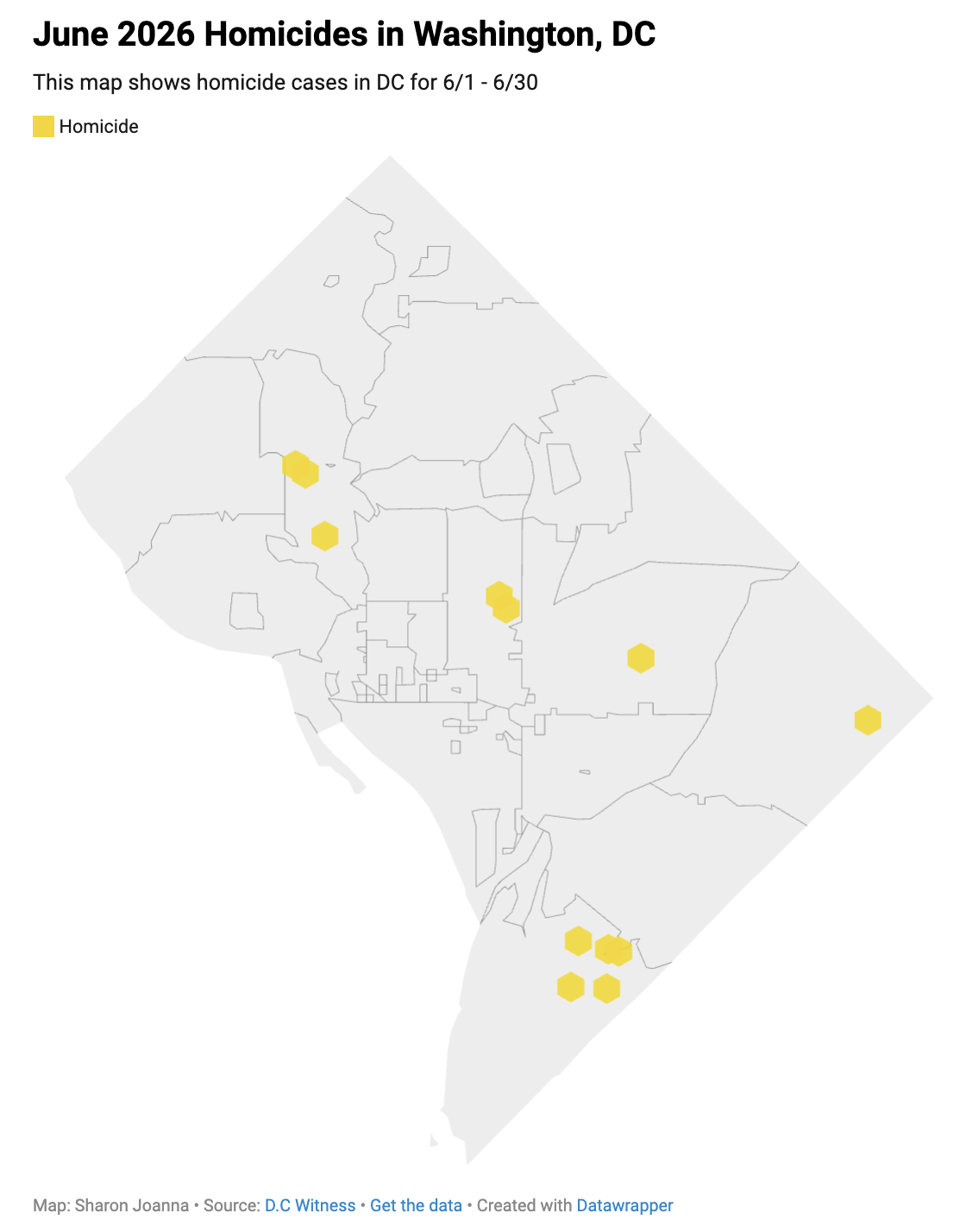
According to D.C. Witness data, there were 12 reported homicides in June, each claiming one victim. This is about a 71 percent increase from the previous month when there were seven reported homicides. 

Of the 12 homicides reported, five of them occurred in Ward 8, nine were shooting-related incidents and no arrested suspects in eight cases. 

As of July 6, the Metropolitan Police Department (MPD) has identified three suspects allegedly involved in the crimes. 

According to MPD, on June 16, officers shot 44-year-old Shawn Williams on a WMATA bus near the intersection of Wisconsin Avenue and Upton Street, NW, while in pursuit of Williams for his alleged involvement in the fatal shooting of 44-year-old Melissa Wallace-Pulliam. 

Wallace-Pulliam was shot and killed on the 3500 block of Wisconsin Avenue, NW in a domestic-related incident. Police officers involved in the shooting were placed on administrative leave. Both victims succumbed to their injuries at their respective scenes. 

Two of the 12 reported homicides included traffic related accidents, including a fatal crash that resulted in the arrest of three suspects.

According to MPD, three suspects allegedly fled in a stolen vehicle when United States Park Police attempted a routine traffic stop, leading to a collision with a moped that resulted in the death of 46-year-old Nolberto Meza on the William Howard Taft Bridge towards Connecticut Avenue, NW on June 20. 

24-year-old Tomas Anderson was charged with second-degree murder and the vehicle’s other occupants, 19-year-old Donnie Palacios and a 16-year-old juvenile male, were charged with unauthorized use of a vehicle during a crime of violence. 

According to MPD, J’Von Green, 33, was arrested and charged with possession of an unregistered firearm and ammunition, carrying a pistol without a license, and criminally negligent storage of a firearm for allegedly leaving a firearm unattended, which was used in the fatal shooting of his goddaughter’s friend, 15-year-old Journee Long, at the 900 block of Barnaby Street, NE, on June 6. 

MPD is also investigating the fatal shooting of 20-year-old Adrian Hawkins, who was found unconscious on June 10 on the unit block of Banner Lane, NW. A juvenile female also sustained several gunshot wounds but was treated for non-life threatening injuries. 

MPD is offering rewards for information about the unsolved cases.

Judge Allows Missing Stabbing Defendant More Time to Find Housing

DC Superior Court Judge Todd Edelman accepted the defense’s request for more time to obtain housing for a stabbing defendant set for release on electronic monitoring in a July 1 hearing.

Shauntia Daniels, 27, is charged with assault with a dangerous weapon for her alleged involvement in a stabbing at a 7-Eleven on the 3000 block of 14th Street, NW, on May 23. A victim sustained stab wounds to the upper chest and forearm.

Judge Edelman raised concerns with parties that Daniels’ friend, who had previously stated could have Daniels stay with her while she was on release, changed her mind. 

Daniels’ attorney, Terrence Austin, asked for more time to secure housing for Daniels, emphasizing that she has no intention of contacting the victim.

Judge Edelman expressed concerns that the location of Daniels’ home is a “walk away” from the victim’s residence, and reiterated the importance of considering other options.

After the hearing, Daniels failed to appear for orientation and GPS monitoring installation. An extraditable bench warrant was issued and served on July 2.

Parties are slated to reconvene on July 14.

Homicide Defendant in Georgia Jail, Prosecutor Asks Judge to Reissue Return Order

DC Superior Court Judge Jason Park reissued a writ to bring a homicide defendant back to DC in a hearing on July 2. 

Dijon Williams, 27, is charged with first-degree murder while armed with aggravating circumstances, conspiracy, two counts of possession of a firearm during a crime of violence, attempt to commit robbery while armed, and carrying a pistol without a license outside home or business. These charges stem from Willliams’ alleged involvement in the fatal-shooting of 30-year-old Nurudeen Thomas on July 21, 2020 at the 4100 block of 14th Street, NW.

On April 3, Williams was rearrested in Lawrenceville, Georgia allegedly for aggravated assault, false imprisonment and willful obstruction of law enforcement. Thus, Williams has been incarcerated in Georgia and unable to appear in court in DC. Although his presence in court was waived, Williams’ bench warrant remains outstanding.

The prosecutor proposed that Judge Park reissue a writ after Williams’ arraignment for the charges in Georgia on July 14. This will allow Williams to be transferred to DC and give both parties more time to develop their arguments for the upcoming trial in September. 

Parties are slated to reconvene on July 15.

Second-Degree Murder Defendant Labeled ‘Unrestorably Incompetent’

A specialist in brain function testified that a murder defendant was mentally incompetent to stand trial before DC Superior Court Judge Todd Edelman in a motions hearing on June 29. 

Daniel Simon, 41, is charged with second-degree murder while armed and carrying a dangerous weapon outside of a home or place of business for his alleged involvement in the fatal beating of Michael Jones, 52, on the 200 block of 15th Street, NW, on Jan. 4, 2023.

“He’s unrestorably incompetent,” declared a neuropsychologist expert during questioning by Simon’s attorney, Molly Bunke. According to the expert, if Simon failed to take his medication, “his [schizophrenic] symptoms are quite severe.” 

The expert also said Simon’s demonstrated symptoms of schizophrenia (delusional thinking) and third-grade reading level indicate a “cognitive deficit.”

During cross-examination, the prosecution asked about Simon’s psychiatric history. The expert explained that Simon’s incompetency diagnosis in 2012 does not definitively confirm or repudiate Simon’s current mental competence.

When questioned by the prosecution, the expert confirmed that his single two-and-a-half-hour session with Simon assessed his overall intelligence, cognitive abilities and neurological processing.

The expert explained the results of two tests he administered to determine if Simon was faking mental illness. They do not determine if Simon received was legally competent to stand trial, meaning he understood the charges and could help his lawyer.

The Inventory of Legal Knowledge (ILK) is used to test whether a defendant may be faking sufficient legal knowledge. A high ILK score may indicate an individual is responding with honesty, while a low score may indicate an individual is responding with deliberate incompetence or malingering.  

Prosecutors argued Simon’s score was high, but the expert said, “I wouldn’t say it’s high.” 

The expert also conducted a Word Choice Test (WCT), to determine whether Simon was struggling to answer each question correctly. The expert said Simon’s 43 WCT score could be explained by feigned incompetence, but also said schizophrenics and second language English speakers may score in the same range without feigning incompetence.

The expert admitted that while “establishing cause” of a neurological disorder is hard, there is evidence that one exists. 

The same expert interviewed Simon as a part of a Competency to Stand Trial (CST) assessment. This assessment is intended to confirm that the defendant could understand the charges against him and help his lawyer fighting those charges. 

During the CST, the expert said Simon knew the seriousness of his charges, but did not initially understand the difference between first-and second-degree murder in terms of premeditation. Once the expert explained the difference, he asked Simon to repeat his newfound understanding. The expert said Simon’s explanation was “very, very similar” to his own. 

While Simon’s case was pending, a jail error resulted in a mix-up of ID numbers and wrist-bands. The expert said Simon “seemed to believe” a conspiracy was unfolding against him. 

Simon’s attorney asked the expert if it is common for a delusion to have some basis of fact. “Just about every delusion starts with a kernel of truth,” the expert said.

Bunke disputed previous testimony from an expert in forensic psychology, who said under oath that Bunke did not return her calls. Bunke said she had an investigator analyze her phone records and found otherwise.

Edelman said a proffer could potentially make something big out of something “quite subsidiary,” and asked Bunke to have the investigator submit a statement to the court.

Parties are scheduled to reconvene on July 1.

Sanity Eval Delays Double Homicide Case

DC Superior Court Judge Todd Edelman postponed a double homicide case on July 2 after the DC Department of Behavioral Health (DBH) failed to complete a court-ordered criminal responsibility evaluation, in other words determining whether a defendant was legally insane when committing the crime.

Ronzoni Jackson, 26, is charged with two counts of first-degree premeditated murder while armed, two counts of possession of a firearm during a crime of violence, and unlawful possession of a firearm for his alleged involvement in the fatal shootings of brothers 35-year-old Osmine Quintano and 28-year-old Octavio Quintano on Dec. 12, 2023, on the 2300 block of 4th Street, NE.

Jackson’s attorney, Sellano Simmons, told the court that the defense is still waiting for DBH to complete Jackson’s criminal responsibility evaluation, which was ordered months ago. According to the parties, DBH expects to issue its report within the coming weeks.

A criminal responsibility evaluation determines whether a defendant can be held legally responsible for their actions at the time of the offense because of a mental illness.

Simmons requested another status hearing after the report is completed so the defense can review its findings before the case proceeds.

The prosecution told the court that they have already begun searching for their own expert to evaluate Jackson if necessary. However, they cannot respond with an independent evaluation until DBH issues its report.

Judge Edelman set a July 17 deadline for the parties to provide updates regarding expert witnesses and reminded counsel that any expert disclosures must comply with Rule 16, which governs the exchange of evidence and expert information between the parties before trial.

Parties are set to reconvene for another status hearing on Aug. 4.

Defendant Accepts Plea Agreement Admitting, ‘I’m Scared to Go to Trial’

A shooting defendant accepted a plea deal on June 29 before DC Superior Court Judge Robert Salerno.

Omari Nkusi, 24, was originally charged with assault with a dangerous weapon, possession of a firearm during a violent crime, unlawful possession of a firearm, attempted strangulation, simple assault, two counts of destruction of property, and obstruction of justice for his alleged involvement in a domestic violence shooting that occurred on Jan. 15 on the 3400 block of Stanton Road, SE. The victim sustained injuries on her cheek from the incident.

During the hearing, John Belcher, Nkusi’s attorney, alerted the court of his intent to accept a deal which would require Nkusi to plead guilty to assault with a dangerous weapon and simple assault, in exchange for a dismissal of all other charges. 

As part of the plea agreement, the prosecution agreed to reserve step back–the option of sending the defendant to jail waiting sentencing– agree to a sentence in the middle of the guidelines, waive sentencing enhancements, make sentencing recommendations, and not oppose sentencing under the Youth Rehabilitation Act (YRA), which gives the judge sentencing flexibility and allows a young defendant’s conviction to be sealed if they successfully complete all sentencing requirements.

The prosecution confirmed that, had the case gone to trial, they would have proven beyond a reasonable doubt that Nkusi arrived at his girlfriend’s residence, strangled and assaulted his her before firing a gunshot toward her family members outside.

Judge Salerno asked Nkusi if the prosecution’s proffer of facts was accurate, to which Nkusi responded, “I signed it because I’m scared to go to trial.”  

The judge clarified that Nkusi would not be able to plead guilty if he does not agree to every fact in the proffer. “I just want to get this over with,” Nkusi said. “No, this isn’t how this works,” Judge Salerno responded.

As the judge read through each paragraph of the proffer, Nkusi requested to make one edit, changing the verbiage from “came to the residence” to “was at the residence” at the time of the offense. After the edit was reviewed, Nkusi confirmed that the proffer was true and accurate.

Nkusi asked Judge Salerno if he may be released on GPS monitoring. “I just want to see my children,” the defendant said.

Nkusi’s attorney, John Belcher, motioned for the defendant’s release to the custody of his mother as he awaits sentencing. Belcher emphasized Nkusi’s role as a dedicated father and his desire to work again to be able to support his children.

The prosecution objected requesting Nkusi remain jailed due to the violent nature of the offense, multiple victims, and the fact that he was on supervision at the time the offense occurred. 

Judge Salerno agreed and ordered Nkusi remain held due to the serious nature of his conduct and one of his prior convictions was for possessing a firearm.

Parties are slated to reconvene on September 18.

‘She’s a Monster in My Children’s Nightmares,’ Says Stabbing Victim At Sentencing

DC Superior Court Judge Robert A. Salerno imposed a partially suspended sentence on a stabbing defendant on June 25. 

On April 28, Cheyenne Brewington, 33, pleaded guilty to assault with a dangerous weapon for her involvement in a non-fatal stabbing on Nov. 28, 2025, at the 1500 block of Young Street, SE. One individual sustained injuries during the incident. 

During the hearing, the prosecution called the victim of the stabbing, a former friend of Brewington’s, who delivered an impact statement asking the court to show the defendant “no mercy”. 

The victim recounted the events on the day of the incident, stating she and the defendant planned to celebrate Thanksgiving with their families at the victim’s  apartment. The victim and Brewington stopped by a liquor store earlier that day, and she recalled the defendant drinking excessively and acting aggressively to those attending. 

The victim claimed that Brewington’s daughter “was afraid she was going to beat her.” She also claimed that Brewington punched her in the face for trying to protect the defendant’s daughter. 

According to the victim, Brewington chased her and assaulted her with brass knuckles and a knife, leaving puncture wounds in her arm and back, all in front of her children.

The victim cited her struggles since the incident, including the loss of her job, self-inflicted mental trauma on herand her children, and lingering physical pain. “She’s a monster in my children’s nightmares,” said the victim.

The prosecution pointed out Brewington’s intoxicated state at the time of the incident in addition to her prior criminal history when requesting a sentence.

Brewington’s defense attorney, Lauckland Nicholas, asked that the court consider recent mental illness diagnoses that have allowed Brewington to get help. He argued that the defendant is remorseful and accepts responsibility, appearing “to be a completely different person”. Nicholas requested that Brewington be given a chance on probation.

Judge Salerno acknowledged the defendant’s growth and the severity of the crime. He sentenced Brewington to 40 months in prison, all of which was suspended but 18 months, and three years of supervised release suspended. Additionally, Brewington must serve two years of probation with mental health fulfillments, substance testing, and a payment of $100 to the Victims of Violent Crime Fund.

No further dates were set.  

Judge Accepts Global Plea for Defendant Facing Three Cases

A defendant pleaded guilty to two charges resulting from a carjacking incident and two other cases in front of DC Superior Court Judge Jenifer Di Toro on June 23.

Kayvon Bell, 24, was initially charged with armed carjacking for his involvement in an incident on the 3200 block of 15th Place, SE on March 11. 

Bell accepted a global plea deal on June 23, pleading guilty to assault with a dangerous weapon and carrying a pistol without a license, which resolved all three of his open cases. Only the assault with a dangerous weapon charge was attributed to the carjacking incident.

The carjacking involved three other suspects: Zoe Jackson, 27, Cordell Rawls, 27, and Justin Ferguson, 26. During the incident, Bell and his accomplices allegedly followed a car dealer before attacking him and taking his Chevrolet Malibu. Bell was arrested and charged with armed carjacking on March 25. 

Bell was additionally charged with contempt for entering a location from which he had been banned, as well as carrying a pistol without a license and possession of a prohibited weapon on a prior arrest. 

Bell’s defense attorney, Lisbeth Sapirstein, claimed that the defendant should be released on home confinement for the two months leading up to his sentencing to be with his family following his brother’s passing. Additionally, she claimed that Bell’s risk of violence would be low on release, citing that he was not involved with the firearm and taser use involved in the carjacking.

Prosecutors claimed that although he did not personally use the weapons, he did “chase the complainant down” and was a “substantial participant” in the incident. 

Judge Di Toro ruled that because of the magnitude and plurality of his cases, the defense’s argument was not sufficient to rebut the presumption that his release wouldn’t pose a threat to the community.

The other three suspects in the carjacking case are expected to reconvene for a felony status conference on Aug. 17. 

Sentencing for Bell has been scheduled for Aug. 24.