Search Icon Search site

Search

Judge Orders Additional Mental Competency Evaluation for Reluctant Homicide Defendant

DC Superior Court Judge Todd Edelman ordered an additional mental competency evaluation for a vehicular homicide defendant during a hearing on Aug. 7. 

Kyle Piunti, 37, is charged with second-degree murder and three counts of assault with a dangerous weapon for his alleged involvement in the death of 54-year-old Michael Hamlin, who was pronounced dead at the scene after being struck by a vehicle traveling southbound on Highway I-295 on Jan. 3, 2024.  

Judge Edelman said a report by the Department of Behavioral Health (DBH) concluded they were unable to evaluate Piunti’s mental competency due to his refusal to participate in the process. 

To stand trial, Piunti must understand the charges against him and be able to assist in his defense.

Judge Edelman said that Piunti needed a competency evaluation to stand trial since he wants to represent himself. As a result, he ordered another evaluation and in-patient competency restoration at Saint Elizabeths Hospital.

“You declared me competent on May 29,” said Piunti.

Prosecutors clarified that Judge Edelman did not make any rulings about Piunti’s competency on that date. 

Judge Edelman said on June 26 he explained in “great detail” red flags he found regarding Piunti’s mental competency. 

Piunti said he did not receive any transcripts from previous hearings or any new evidence from the prosecution.

“I’m not a lawyer,” said Piunti and argued he did not know how to respond to the court without the case information.

Judge Edelman said he was concerned by the defendant’s repeated interruptions in court. 

Parties are scheduled to reconvene on Sept. 18.

Prosecutor Describes Bus Stop Shooting as ‘Surprising’ and ‘Unexpected Conduct’ From Defendant

The prosecution and defense both agreed that a shooting was out of character for the defendant at a sentencing before DC Superior Court Judge Andrea Hertzfeld on Aug. 10.

D’Andrea Grayton, 52, pleaded guilty on June 2 to assault with a dangerous weapon and unlawful possession of a firearm with a prior conviction. The charges stem from his involvement in a shooting on Sept. 14, 2025 at a bus stop on the 1700 block of Minnesota Avenue, SE. The victim sustained a gunshot wound to his right thigh.

Judge Hertzfeld sentenced Grayton to 18 months in prison for the assault charge and 12 months and one day for the possession charge. The charges will run concurrently with all but 12 months and one day suspended. Following his imprisonment, Grayton must serve one year of probation, register as a gun offender in DC, and stay away from the victim.

Under the First Step Act (FSA) of 2018, federal inmates can earn time credit towards their sentence for good behavior, program participation, and educational achievements. However, the FSA earned time credits only apply to sentences more than one year. 

The prosecutor said the offense was “surprising conduct and unexpected conduct” from Grayton, an older man with work history and family support. Following an argument at a bus stop, Grayton retrieved his gun, returned, and shot the victim in the leg.

“In a civilized society, that’s just not a way to solve your problems,” emphasized the prosecutor. 

The prosecution requested Grayton serve 18 months in prison for assault and 12 months for possession, to run concurrently, followed by three years of supervised release. 

“Yes it was an overreaction, but he was threatened with a gun first,” claimed Grayton’s attorney, Matthew Rist. According to Rist, the victim put his hand inside his backpack as if he had a gun and gestured it towards Grayton. Regardless, Rist acknowledged that his client’s actions were not justified.

Rist also noted that Grayton’s last conviction was 19 years ago, a 2007 misdemeanor. Before that, Grayton committed a 1992 possession of a firearm during a crime of violence offense. Rist highlighted that Grayton completed his last probation successfully.

Rist described Grayton as a “model inmate” at the DC Jail and emphasized his work detail assignment. When Grayton returns to the community, Rist said his former employer of 10 years will welcome him back.

Rist asked the judge to sentence Grayton to 18 months for assault, all but 180 days suspended, to run concurrently with 12 months and one day for possession.

After Judge Hertzfeld imposed her sentence she said “Good luck to you Mr. Grayton.”

No further dates were set.

Victim Claims Domestic Abuse Suspect Threatened “to Shoot You [and] I’m Going to Your Mom’s House and Shoot Her!”

A defendant accused in a quarrel of stabbing his pregnant on-again-off-again romantic partner was arraigned before DC Superior Court Judge Judith Pipe on Aug. 10.  

Jackson Onunaku, 31, heard the charges against him in a six-count indictment for first-degree burglary while armed, assault with a dangerous weapon, two counts of possession of a firearm during a crime of violence and assault with significant bodily injury while armed.

The alleged domestic offenses occurred on Dec. 28, 2025, in an apartment on the 1300 block of Peabody Street, NW.  According to an account from responding officers of the Metropolitan Police Department (MPD), the dispute arose the day of the incident when the victim informed Onunaku in a phone call that she was 12 weeks pregnant with his child.  

When she asked for $100 to help pay for an abortion, she said Onunaku became irate, claiming he was not the father and that the victim was seeing another man.  As the argument progressed Onunaku, according to the victim, said, “I’m going to your house and I’m going to shoot you [and] I’m going to your mom’s house and shoot her!”

Following the call, say police, Onunaku came to the victim’s apartment and kicked open the door.  Once inside, the report says, he struck the victim in the head with a gun, kicked and punched her multiple times and hit her with a barstool.  During the attack, Onunaku allegedly threatened to kill the victim many times with a gun and a knife.  As she attempted to defend herself, the victim suffered knife wounds on her hands saying the assault dragged on for thirty minutes.

During their investigation police found blood smeared around the apartment and the victim identified Onunaku as the assailant and claimed that he had abused her throughout her pregnancy.

At the hearing, Onunaku’s attorney, Matthew Davies, pleaded not guilty on his client’s behalf and asked for the prosecution to turn over any information the victim might have benefitted from her testimony.

He also motioned for the case to be dismissed on the grounds the prosecution failed to file the indictment against Onunaku within the statutory deadline.  However, Judge Pipe denied the request saying that the charges were filed well in advance of the Oct. 5 trial date.

The judge also ruled that Onunaku must remain in jail. 

The next hearing in the case is scheduled for Sept. 4. 

Multiple Fingerprints at Homicide Scene Reportedly Match Defendant, Victim

A medical examiner, chief deputy toxicologist, and fingerprint examiner testified in a homicide trial before DC Superior Court Judge Neal Kravitz on Aug. 5. 

Vanessa Bonaparte, 34, is charged with first-degree premeditated murder and destruction of property worth more than $1,000 for her alleged involvement in the fatal stabbing of 31-year-old Dwayne Boyd on the 3500 block of East Capitol Street, SE on June 22, 2024. Bonaparte had a sexual relationship with Boyd, according to Metropolitan Police Department (MPD) detective testimony at a motions hearing on July 20. 

A fingerprint specialist that performs contract work for the Department of Forensic Sciences (DFS) testified. The expert said he identified multiple prints attributed to Boyd, Bonaparte and another witness on the scene.

The witness said he analyzes evidence left at the scene through scanned images to find latent fingerprints, an unintentional recording of a fingerprint, and compares them to known fingerprints, intentional recordings a fingerprint, to verify if there is a match.

Across 34 latent fingerprints, the expert found 16 verified prints across three pieces of evidence, one of which was a window pane at the scene, that reportedly matched palm and fingerprint impressions made by Bonaparte, Boyd and a witness.

Upon cross-examination, Bonaparte’s other attorney, Roderick Thompson, questioned the affiliation the fingerprint expert has with DFS. The expert said that DFS and his firm are two separate entities with different operating procedures, but more than 95 percent of his job is working with DFS, although he no longer works on-site with them.

The expert confirmed he told another one of Bonaparte’s lawyers that payment was required to talk about the case. 

Upon redirect, the expert clarified that his company as a private entity is paid for by the prosecution.

Prosecutors called the deputy medical examiner at the Office of the Chief Medical Examiner (OCME) who conducted Boyd’s autopsy. The medical examiner determined Boyd’s cause of death to be two stab wounds to the upper left and right sides of his chest.

The wound on the right side of Boyd’s chest was five inches deep and damaged his skin, pectoralis muscles, musculature between his ribs, and right lung, according to the medical examiner. The witness said the wound on Boyd’s left side was six-and-a-half inches deep and damaged his chest plate, pericardial sac, and perforated the left ventricle of his heart, meaning the weapon entered and exited through his heart. 

The medical examiner explained that the torso and ribs are compressible, like a sponge. As a result, the witness said a knife may enter a body when the abdomen is compressed, and later, when the abdomen expands, the wound may be larger than the blade that caused the injury. 

Aside from the two stab wounds, Boyd had no other apparent injuries the day he died, according to the medical examiner. She concluded Boyd’s death was a homicide.

In cross-examination, Bonaparte’s attorney, Kevann Gardner, confirmed that the medical examiner could not tell the order in which the wounds were inflicted, the position of Boyd’s body at the time he was stabbed, or the position of the person who stabbed Boyd. 

When Gardner asked if the wounds could be consistent with Boyd choking a woman, who then managed to get a hold of a knife and stab him, the medical examiner said, “I suppose it’s possible.” 

The deputy chief toxicologist at OCME testified that Boyd had a 0.07% Blood Alcohol Concentration (BAC), which is below the legal limit of 0.08% BAC to operate a vehicle in DC. 

In cross-examination, the toxicologist, a specialist in dangerous drugs, clarified that OCME’s testing reflects only the level of a substance in Boyd’s body at the time of death and would not detect compounds from weeks, days, or possibly hours earlier.

Other studies show Boyd tested positive for methamphetamine, a stimulant known as meth and the possible presence of methylenedioxymethamphetamine (MDMA), the hallucinogen called Molly, but the estimated concentration was too low to meet OCME’s reportable limits. 

After the jury left, Judge Kravitz told the prosecution that invoices they plan to show in court that estimate the cost of replacing windows that Bonaparte allegedly damaged do not represent the “fair market value” of windows at the time of damage. He said the prosecution may have to charge Bonaparte with a misdemeanor instead of a felony for destruction of property. 

Prosecutors said they would examine case law to determine how to proceed with the charge.

Parties are scheduled to reconvene on Aug. 6.

D.C. Witness Investigation Shows DNA Limitations in Homicide Trials

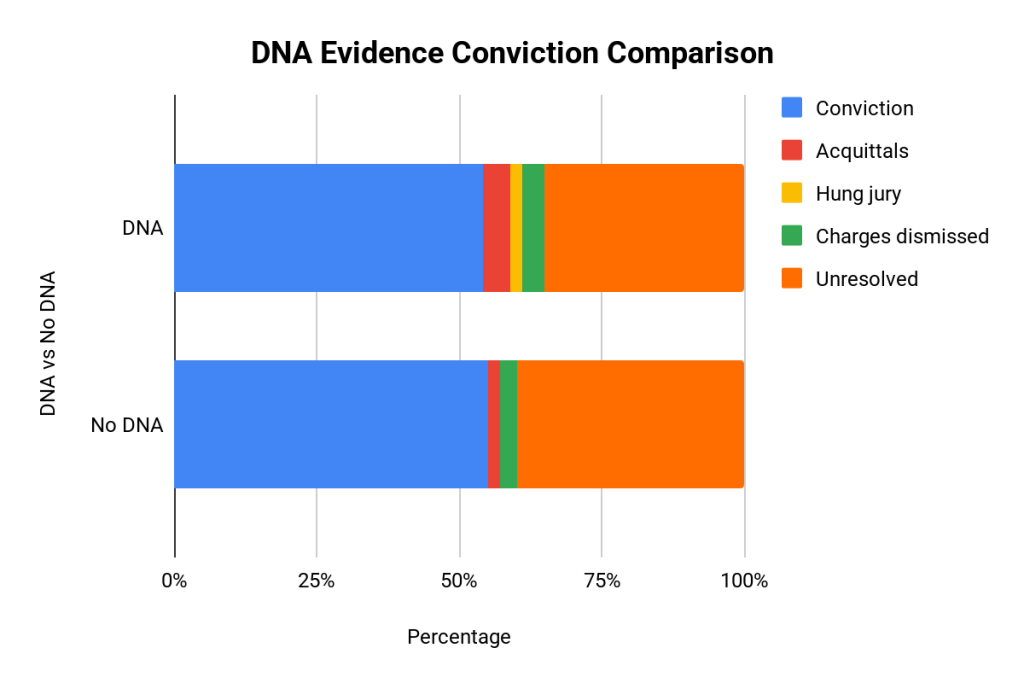
Though DNA evidence is often considered the “gold standard,” records show other forms of evidence result in slightly more murder convictions. 

D.C. Witness reviewed 165 homicide cases from November 2023 to March 2026  involving recovered DNA, a substance which can be linked with mathematical precision to a defendant’s biological make up. In the 57 cases where DNA was a factor, the conviction rate was slightly lower compared to verdicts rendered through other forms of evidence. 

Consider Julian Ruffin’s case.  He was accused of fatally stabbing a 38-year old man in October of 2022.  As the trial proceeded the prosecutor introduced a bloody knife and blood-stained T-shirt recovered from a search warrant of Ruffin’s apartment.  That evidence investigators say not only contained DNA linked to the victim but Ruffin’s as well. 

Ruffin’s attorney, Kevin Irving, countered that since the two men were engaged in an argument prior to the murder, blood and spit containing DNA could easily have been transferred to the evidence unrelated to the crime. 

Irving’s argument convinced the jury to acquit Ruffin in April of 2025, despite the DNA evidence, on the grounds of self-defense

           165 Homicide Cases From 2023 to 2026 With and Without DNA Evidence

DNA vs No DNATotal CaseConvictionAcquittalsHung JuryCharges dismissedUnresolved
No DNA65% (108)55% (60)2% (2)0% (0)3% (3)40% (43)
DNA35% (57)54% (31)5% (3)2% (1)4% (2)35% (20) 

Daniele Podini, Ph.D, is an associate professor at George Washington University who specializes in DNA technology. He calls DNA evidence “very compelling,” given that it is both sensitive and highly precise.  

We all share 99 percent of the same DNA, but one-tenth of the molecule is unique and determines core inherited characteristics like hair, skin, blood or saliva.

While fingerprints are distinctive, they may degrade over time. During proceedings bullet fragments, social media posts, phone records, surveillance footage and particularly eyewitness accounts, says Podini, can be linked to a defendant’s identity with varying degrees of accuracy.

DNA is different. It can survive intact for decades or centuries.  It can also be quantified and digitized in records that are easily stored. 

However, just because a person’s DNA is on the evidence, it can’t tell you who actually committed the crime, Podini said. One reason is that trace amounts of “touch”  DNA recovered from other suspects or victims need to be factored into the analysis–a frequent argument made by the defense.  

Analyzing DNA can take months and cost tens-of-thousands of dollars depending on the complexity and amount of the evidence, Podini said. Plus the defense has the legal right to conduct its own DNA testing. Further, there must be enough DNA to warrant the effort and expense.  

“It ultimately depends on how relevant and probative the underlying evidence is from which the DNA profiles are generated,” says Podini.  Even though he calls it the “gold standard,” the data shows the technology has limited effectiveness in the courtroom. 

‘Her Contradictions Contradict Themselves,’ Says Defense About Witness in Fatal Stabbing Trial

Both parties agreed that an eyewitness was unreliable and unpredictable in a homicide trial before DC Superior Court Judge Neal Kravitz on Aug. 4.

Vanessa Bonaparte, 34, is charged with first-degree premeditated murder while armed and destruction of property valued at $1,000 or more. The charges stem from her alleged involvement in the fatal stabbing of 31-year-old Dwayne Boyd on June 22, 2024 on the 3500 block of East Capitol Street, SE. Boyd sustained two stab wounds to his chest and died on the scene. 

The unpredictable witness was a neighbor and friend of both Boyd and Bonaparte who reportedly told investigators that Bonaparte threatened to harm her if she spoke about the incident. 

Bonaparte’s attorneys, Kevann Gardner and Roderick Thompson, argued that the witness should be instructed to withhold that information in her testimony before the jury. 

Meanwhile, the prosecution asked to keep the door open as they worry the witness would disregard instructions regardless. 

Both the prosecution and the defense painted the witness as unreliable and unpredictable. According to prosecutors, although she was questioned about this conversation during her grand jury testimony, she failed to mention the alleged threat from Bonaparte.  

Furthermore, the prosecution claimed the witness provided a false name, address, and date of birth to the police, and never wanted to be a part of the investigation, possibly out of fear.

Thompson asserted there was no shortage of reasons to question the witness’ credibility. “Her contradictions contradict themselves,” Thompson added.

Gardner and Thompson also alleged that the prosecution knew about the witness’ accusation in time to formally include it in their Drew Johnson notice, which would have allowed the defense time to file a motion to exclude the evidence. Under DC law, a Drew Johnson notice is the prosecution’s formal request to introduce evidence of a defendant’s uncharged prior bad acts. 

Judge Kravitz called-out the prosecution for not notifying the defense of the accusation sooner, and said he likely would have allowed the evidence as a useful tool for the prosecution’s case against Bonaparte.

“It’s excluded from your direct because you didn’t give proper notice of it,” Judge Kravitz said to the prosecution.

Judge Kravitz ruled that the witness should be told to withhold the information at least during the prosecution’s direct examination. Afterwards, the parties can decide whether to address it. 

When the prosecution brought the witness to the stand, she followed the instructions and withheld the information as Judge Kravitz ruled. 

With the jury present, the witness testified that Bonaparte “was like a sister,” and someone who her children called “auntie.” Living in the same apartment building as Boyd, she testified that she frequently saw Boyd and Bonaparte together.

The witness also mentioned that she had seen Boyd with another woman, though she did not know the woman’s name.

At first, the witness testified that she met Boyd at a nearby liquor store. When confronted with her grand jury testimony, she changed her testimony to state that she met Boyd in the apartment building. 

According to the witness, she and Boyd texted frequently. The day he died, Boyd sent the witness a voicemail, which was played in court. The witness identified Boyd and Bonaparte’s voices when she was on the stand.

In cross examination, Thompson asked the witness if she knew information about Boyd’s engagement to the other women. The witness said no. Boyd “would have told you?,” Thompson asked and the witness confirmed he would have. 
Thompson also clarified that the witness previously testified about a third voice that she did not recognize in the voicemail. The witness agreed.  

A Metropolitan Police Department (MPD) officer then testified. She responded to a domestic violence call on June 7, 2024 at the apartment where Boyd was later killed. Alongside her body-worn camera footage shown in the courtroom, she explained that there didn’t appear to be any broken glass on the premises.

During cross-examination, Gardner asked the officer if she knew what happened in the weeks after she responded to the domestic violence call, and she did not. Gardner also asked if she believed it would be possible for the apartment’s windows to have been broken, and remain broken, for multiple weeks. She said yes.   

The prosecution alleges that Bonaparte shattered the apartment windows the night of Boyd’s death.

Another MPD officer was brought to the witness stand who responded to a call the day Boyd was stabbed. Her body-worn camera footage showed the neighbor witness who testified earlier in the day and Bonaparte leaving the scene as officers arrived. The officer also shared footage without audio that showed the neighbor witness talking to police later that night.

The officer testified that police covered up broken windows in Boyd’s apartment with sheets to deter onlookers. In addition, the officer noted that there were no weapons recovered near Boyd’s body.

In cross-examination, Gardner asked if the officer knew the condition of the windows prior to the incident. The officer confirmed she did not. Gardner also asked if the officer knew the events that led to Boyd’s death and the officer said she did not.

The prosecution also called a witness from the Department of Forensic Sciences (DFS) who investigated and documented the scene. He measured and sketched diagrams of the windows in the apartment, and later returned to take photos of the building and nearby apartments. 

During cross-examination, the forensic scientist explained that one of the prosecutors in this case asked him to take the photos.

Parties are slated to continue the trial on Aug. 5.

Defendant Sentenced Under Youth Act to 12 Years for Shooting and Carjacking Cases 

DC Superior Court Judge Deborah Israel sentenced a 20-year-old shooting and carjacking defendant under the Youth Rehabilitation Act (YRA) to 12 years of imprisonment on July 31. 

Aaron Tolliver, 20, pleaded guilty on Aug. 18, 2025 to aggravated assault knowingly while armed and possession of a firearm during a crime of violence for his involvement in a shooting on Feb. 8, 2025 on the 2600 block of Stanton Road, SE. A juvenile victim sustained a gunshot wound to his left calf. 

In a separate case, Tolliver pleaded guilty on the same date to unarmed carjacking and robbery for his involvement in a carjacking on Dec. 22, 2024 on the 1700 block of 4th Street, NW and a robbery on Dec. 23, 2024 on the 1300 block of Florida Avenue, NW.

Tolliver’s sentencing was delayed to allow him to complete high school at the DC Jail. 

As part of the plea deal, parties agreed to a 12 year total prison sentence for both of Tolliver’s cases, five years for the shooting and seven years for the carjacking. The sentences were under rule 11c1C and subject to Judge Israel’s approval at sentencing.

According to the prosecution, Tolliver approached a young woman with a gun and carjacked her. Tolliver later shot another person with a firearm in a separate offense, noted the prosecutor and described his actions as “severe conduct that has been escalating.”

The prosecution requested Judge Israel honor the 12 year sentence under the 11c1C and authorize supervised release for Tolliver. The prosecutor also argued against sentencing Tolliver under the YRA, emphasizing the seriousness of the offenses.

The YRA allows sentencing flexibility for defendants who commit crimes under the age of 25. Under the YRA, a judge can impose sentences below the mandatory minimums and offenders have the opportunity to have their convictions sealed upon successful completion of requirements.

Tolliver’s attorney, Lauren Morehouse, stated that Tolliver used his time at the jail to “put his money where his mouth is.” Morehouse emphasized that Tolliver graduated high school with straight A’s despite learning disabilities. In addition, Morehouse said Tolliver accepted responsibility for his actions and demonstrated self-reflection and personal growth over the past two years. 

Morehouse asked Judge Israel to accept the 11c1C agreement, sentence Tolliver under the YRA, and impose probation instead of supervised release.

Tolliver then read a letter to Judge Israel in which he apologized to the victims and their families for the trauma he caused. He expressed remorse for his actions and said he hopes to learn a trade so he can find employment after his release.

Judge Israel said she was “on the fence” about applying the YRA because the offenses were committed months apart and involved multiple victims. However, she said Tolliver had shown maturity by completing high school, adding that his progress reflected “the underpinning of the reasons YRA exists” by giving young defendants an opportunity to grow.

Judge Israel decided to honor the 11c1C agreement and concluded that YRA sentencing was appropriate. In the carjacking case, she sentenced Tolliver to seven years in prison for carjacking and five-and-a-half years for robbery, to run concurrently.

In the shooting case, Judge Israel sentenced Tolliver to five years in prison for aggravated assault and five years for possession of a firearm, to run concurrently.

The sentences in the two cases will run consecutively, totaling 12 years, followed by three years of supervised release.

Judge Israel explained that in order to receive the benefit of the YRA sentence, Tolliver must complete 200 hours of community service on supervised release. He is also required to register as a gun offender upon his release.

No further hearings dates were set.

Judge Tells Teen Carjacker, ‘I’m Proud of You’ Before Imposing 7 Year Sentence

DC Superior Court Judge Deborah Israel sentenced an 18-year-old carjacking defendant to five years in prison under the Youth Rehabilitation Act (YRA) on July 31. 

Mekhi Greene, 18, pleaded guilty on Sept. 19, 2025 to unarmed carjacking for his involvement in an incident that occurred on the 3500 block of East Capitol Street, NE, on March 23, 2025. The victim was a mother whose toddler was inside the vehicle during the offense.

Greene was formerly charged with armed carjacking and possession of a firearm during a crime of violence. Both charges were dismissed as part of his plea deal. The prosecution also agreed to limit their sentencing request to seven years in prison.

Judge Israel sentenced Greene’s co-defendant, 20-year-old Keon Preston, on May 15 to 15 years in prison, all but eight suspended, followed by three years of supervised probation. Preston pleaded guilty to unarmed carjacking, assault with intent to kill, and felony possession of a machine gun for his involvement in the same offense.

According to the prosecution, Greene participated in the carjacking along with three other suspects. Prosecutors said the group surrounded the victim’s vehicle and that Preston pointed a gun at the victim as she exited the car. The prosecutors played surveillance video of the incident in court.

Prosecutors said Greene and Preston were arrested, while the other two suspects fled and were never identified. The stolen vehicle was later recovered with two firearms inside.

The prosecution argued Greene participated in the offense “for sport,” describing it as “how they are spending their Friday night.”

Prosecutors also argued Greene minimized his role by reportedly blaming Preston for carrying the gun and claiming he acted because of peer pressure. They said Greene’s lack of remorse weighed against sentencing him under the YRA and asked the court to impose the seven-year mandatory minimum sentence.

The YRA allows sentencing flexibility for defendants who commit crimes under the age of 25. Under the YRA, a judge can impose sentences below the mandatory minimums and offenders have the opportunity to have their convictions sealed upon successful completion of requirements.

Greene’s attorney, Todd Baldwin, asked his client’s supporters to stand, and 14 of his friends and family members rose in the courtroom. Baldwin displayed emotion as he described Greene’s progress, saying he had “never seen that much change in a client.”

Baldwin presented a photograph of Greene wearing a cap and gown, prompting applause from audience members in the courtroom. He told the court that Greene earned his high school diploma with a four-point-zero grade point average while incarcerated and argued that “if you give him jail time, everything goes away.”

Greene’s education attorney also praised his accomplishments, stating “he promised to get a diploma and he followed through on that promise.” She continued that Greene promises if granted the YRA, “he will be as successful in the community as he has been in jail.” 

The education attorney further explained that Greene was an active participant in the Young Men Emerging (YME) program at the jail and had support from a social worker. 

Greene then read a letter he wrote to Judge Israel, accepting responsibility for his actions. He said he has spent his time incarcerated working to build a better future. Greene claimed he changed for the sake of his younger brother, saying, “He reminds me why I can’t give up” and “I don’t want him growing up thinking this is normal.”

Judge Israel thanked Greene for his letter and told him, “I’m proud of you,” acknowledging his accomplishments while incarcerated and describing them as evidence of discipline and maturity. 

Although the judge noted Greene’s criminal history and the seriousness of the offense involving a mother and her child, she found that his “tremendous amount” of self-reflection warranted sentencing under the YRA.

Judge Israel sentenced Greene to seven years in prison, suspending all but five years, followed by three years of probation. 

To receive the benefit of the YRA, Greene must complete 200 hours of community service, undergo mental health and substance abuse treatment, refrain from possessing firearms or ammunition, and follow a stay-away order from the victim.

No further dates were set.

Victim Expresses ‘a Lot of Love’ for Stabbing Defendant at Sentencing

A stabbing defendant was released after DC Superior Court Judge Robert Salerno sentenced her to probation on July 31. 

Tonya Elliott, 31, pleaded guilty on May 28 to attempted assault with a dangerous weapon for stabbing her romantic partner on Dec. 6, 2025, on the 5400 block of Connecticut Avenue, NW. The victim sustained four wounds to his back. 

At Elliott’s sentencing, the prosecution asked that she serve 12 months of confinement, with all but eight months suspended, followed by 18 months of supervised probation. In addition they asked for Elliott to receive mental health and anger management treatment from the Court Services and Offender Supervision Agency (CSOSA).

The prosecutor acknowledged Elliott’s lack of criminal history, as well her mental health conditions, and shared hope that this sentence would motivate her to seek treatment. 

Matthew Rist, Elliott’s attorney, asked for 12 months of confinement, with all time suspended but the almost eight she already served. Rist also asked for mental health treatment from CSOSA. 

Rist explained that Elliott had become “unstable due to housing issues in 2023,” but had a support system at home willing to help her improve. 

The victim was present in court, and addressed Judge Salerno in support of Elliott. 

“That’s a good friend of mine,” he said. “I got a lot of love for her.” 

The victim insisted he wanted Elliott to return home and that he intended to help her. He also confirmed he did not want the judge to order Elliott to stay away from him. 

“We all fight demons in our life,” he concluded. “I don’t wanna see her locked up for nothing.” 

Judge Salerno then allowed Elliott the opportunity to speak. 

“I just wanna apologize,” Elliott stated. 

Judge Salerno sentenced Elliott to 12 months of confinement with all time suspended, in favor of 12 months of supervised probation. The judge also ordered a “NO HATS” order, that Elliott cannot harass, assault, threaten, or stalk the victim.

Judge Salerno also ruled that Elliott must comply with an intervention plan for her mental health, and said “CSOSA should not be shy” with proposing a probation show cause hearing if needed. 

No further dates were set.

Increased July Homicides Include 2 Traffic Fatalities on July 5

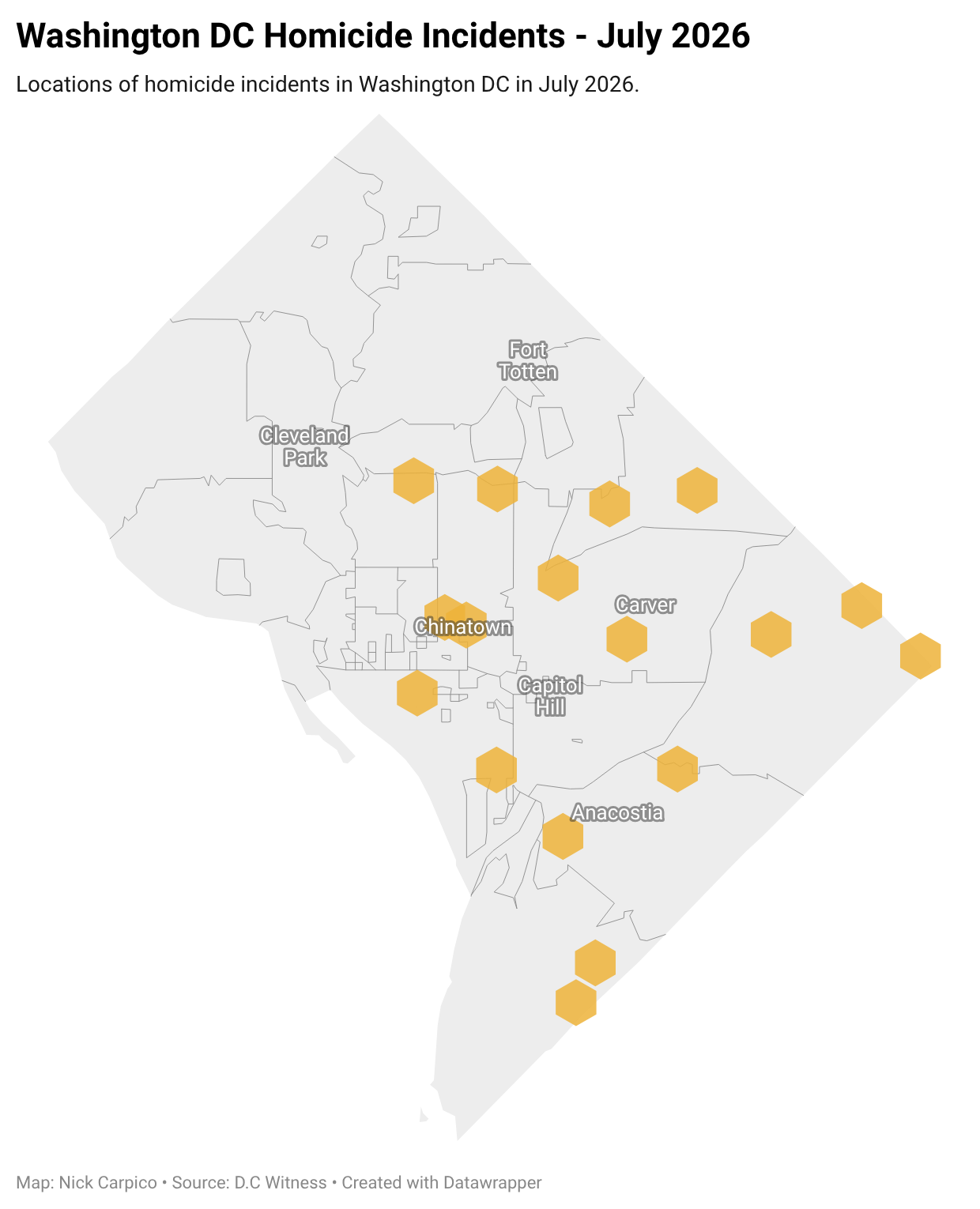
According to D.C. Witness data, there were 17 reported homicides in July, each claiming one victim. This is approximately a 42 percent increase from the previous month when there were 12 reported homicides.

As of Aug. 5, the Metropolitan Police Department (MPD) has identified four suspects allegedly involved in three of the offenses. Two suspects are co-defendants.

According to MPD, on July 11, officers found 27-year-old Aaron Brown Jr. with a gunshot wound in an alleyway on the 4000 block of Minnesota Avenue, NE. DC Fire and Emergency Medical Services (EMS) responded to the scene and transported Brown to a local hospital where he succumbed to his injuries.

Abdoulie Jawneh, 25, was arrested on July 23 and his co-defendant, 23-year-old Daniel Foxworth Jr. was arrested on July 24. Both were charged with premeditated first-degree murder while armed for their alleged involvement in Brown’s death.

Jawneh and Foxworth are both scheduled to appear for their preliminary hearing on Aug. 12.

Among the 17 reported homicides, three were traffic fatalities, two with victims older than 60.

According to MPD, Michael Mills, 55, was arrested on July 5 at the scene of a crash and charged with driving under the influence of alcohol or drugs, operating a vehicle while impaired, failure to stop and give right of way to pedestrians, and leaving after colliding.

The charges stem from Mills’ alleged involvement in the death of 79-year-old Virginia Voight at the intersection of 14th Street and Independence Avenue, SW. Voight was traveling eastbound in a motorized electric mobility scooter when she was struck by a white 2016 Ford F-150 truck. Voight succumbed to her injuries on July 12.

MPD is also investigating the death of 63-year-old Ricky Marshall, who was also struck on July 5 by an unknown vehicle on the 1200 block of Sumner Road, SE before the suspect fled the scene.

In July, gun violence compromised the largest number of reported homicides, with 12 fatal shooting victims.

According to MPD, 13-year-old Ahmad Mims was found fatally shot on a sidewalk on the 1600 block of Rosedale Street, NE on July 11. Investigators determined the shooting occurred inside a home on the block.

MPD is also investigating the death of 32-year-old Marquis Turner, who was shot and killed on the 800 block of 6th Street, NW on July 8. MPD officers transported Turner and another victim who was shot to a local hospital. Later, police learned a third victim sustained injuries in the shooting. No suspects have been identified.

Necho Taylor, 35, is charged with second-degree murder for his alleged involvement in the death of 34-year-old Joshua Foxworth. According to court documents, Foxworth was found dead in a bathtub on July 8 on the 800 block of Barnaby Street, SE. Foxworth sustained puncture wounds to the left side of his body and died from blunt force trauma to his face.

Taylor is scheduled to appear in court again on Aug. 13.

MPD is offering rewards for information about the unsolved cases.

Jury Acquits Defendant of Fatally Stabbing His Girlfriend

A jury acquitted a defendant of a 2023 fatal stabbing before DC Superior Court Judge Danya Dayson on Aug. 5.

Rayvon Slye, 34, was charged with second-degree murder while armed for his alleged involvement in the fatal stabbing of his girlfriend, 30-year-old Andrea Bond, on March 7, 2023 on the 1000 block of D Street, NE. Bond suffered one stab wound to her upper left chest.

According to court documents, Slye and Bond had reportedly been physically violent with each other on multiple occasions. The couple shared an infant child, whom they were not in custody of at the time of Bond’s death.

After less than two days of deliberations, the jury returned a not guilty verdict on the sole charge.

Throughout the trial, which began on July 21, the prosecution alleged that Slye killed Bond in the morning of March 7, 2023 and then reportedly laid next to her until she was discovered unresponsive in the afternoon.

The prosecutors used phone call evidence and witness testimony to demonstrate Slye’s reported history of violence against Bond. They claimed the jury could use Slye’s past to infer about his actions on the night of Bond’s death.

Slye’s attorneys, Kevin Mosley and Kayla Wyatt, argued that Bond was fatally stabbed in a fight with an unidentified woman in the Trinidad neighborhood on the night of March 6, 2023. 

Mosley emphasized the prosecutors lack of physical evidence, including that “not a single drop of blood” was found at the scene where prosecutors alleged Slye stabbed Bond.

The case was closed, no further dates were set, and Slye’s release was ordered from the DC Jail.

Co-Defendants Accept Global Plea Deals for Homicide and Carjacking Offenses

Two co-defendants pleaded guilty for multiple carjacking offenses and a homicide in DC Superior Court Judge Michael Ryan’s courtroom on July 31. 

Christian Ware, 20, Roland Brewer, 21, were initially charged with armed carjacking, two counts of unarmed carjacking, robbery while armed, two counts of robbery, aggravated assault knowingly causing grave risk while armed, assault with a dangerous weapon, first-degree burglary while armed, three counts of possession of a firearm during a crime of violence, unauthorized use of a vehicle, and carrying a pistol without a license outside of home or business. 

Ware was additionally charged with possession of an unregistered firearm, unlawful possession of ammunition, and obstructing justice. Brewer was charged with two additional counts of possession of a firearm during a crime of violence and another count of carrying a pistol without a license outside a home or business.

These charges stemmed from their alleged involvement in four incidents that took place over two months in the summer of 2024:

  • A shooting on July 21, 2024, on the 500 block of 50th Place, NE. A juvenile victim sustained a gunshot wound to his upper left arm,
  • An armed carjacking on June 19, 2024, the 4000 block of Minnesota Avenue, NE,
  • An unarmed carjacking on June 21, 2024, on the 4400 block of Benning Road, NE,
  • An unarmed carjacking on July 1, 2024, on the 4100 block of Hunt Place, NE.

At the hearing, the co-defendants accepted plea deals from prosecutors for three out of the four aforementioned offenses. The prosecutors said they would have proven Ware and Brewer’s involvement beyond a reasonable doubt in all of the offenses except for the June 21, 2024 carjacking.

The agreement required Ware to plead guilty to carrying a pistol without a license and carjacking. Brewer pleaded guilty to aggravated assault while armed and robbery. 

In the deal, Ware also pleaded guilty to voluntary manslaughter in an unrelated case for his involvement in the fatal shooting of 38-year-old Antowine Baker on Aug. 13, 2024 in a park on the 500 block of Division Avenue, NE. Ware was arrested in connection with the murder over a year later.

If the homicide case had proceeded to trial, the prosecution said the evidence would’ve proven Ware’s guilt beyond a reasonable doubt. They said Ware and three other individuals walked around Marvin Gaye Park, and Ware fired multiple shots, striking Baker in the back. Ware acted in conscious disregard for others’ safety, the prosecution contended, and not in self-defense.

In the homicide case, Ware was initially charged with second-degree murder while armed, two counts of possession of a firearm during a crime of violence, assault with a dangerous weapon, and carrying a pistol without a license outside of home or business. 

As part of the plea agreements, parties agreed to a maximum sentence of 10 years in prison for Brewer and 15 years in prison for Ware, subject to Judge Ryan’s approval at sentencing. They will both have to register as gun offenders in DC upon their releases.

For Ware, a third jail-stabbing case was also dropped entirely.

In the jail-stabbing case, Ware was charged with assault with a dangerous weapon for his alleged involvement in an incident on Oct. 21, 2025 at the DC Jail on the 1900 block of D Street, SE.

Judge Ryan confirmed the defendants knew they gave up their rights to a trial and to appeal by pleading guilty, and promised to review the plea agreements before sentencing. 

The prosecutor said Baker’s family intends to provide impact statements at the sentencings scheduled for Dec. 11.

Carjacking, Robbery Co-Defendants Plead Guilty to 6 Charges Each From 87-Count Indictment

Two co-defendants accepted plea deals for their involvement in several offenses before DC Superior Court Judge Rainey Brandt on Aug. 3. 

At the hearing, Hanif Brown, 20, and Deondre Rogers, 20, both pleaded guilty to carjacking, possession of a firearm during a crime of violence, two counts of carrying a pistol without a license, armed robbery, and robbery. The charges stem from their alleged involvement in three separate instances from April 7, 2023 to May 4, 2023 throughout DC.

The plea offers were contingent on both defendants’ acceptance of the terms. 

As part of the agreement, parties set the guidelines for Brown’s sentence between 12-and-17 years in prison. Rogers’ plea deal set 17 years of imprisonment. Both agreed-upon sentences are subject to DC Superior Court Judge Jason Park’s approval at sentencing. 

Brown’s attorney, Andrew Ain, and Rogers’ attorneys, Daniel Dorsey and Tammy Thom, all requested alternative sentencing for their clients under the Youth Rehabilitation Act (YRA). The YRA allows judges to give flexible sentencing and the ability to seal convictions for defendants who commit offenses under the age of 25.

Prosecutors said if the cases had proceeded to trial, they would have proven that on April 7, 2023, Brown and Rogers rear-ended a car in a white Jeep on the 5800 block of South Dakota Avenue, NE. The pair exited the Jeep, approached the car with firearms and told the other driver to exit. They took the car and drove off. 

For their alleged connection to several robbery and carjacking incidents on April 7, Rogers and Brown were formerly charged with four counts of assault with a dangerous weapon, two counts of armed carjacking, seven counts of possession of a firearm during a crime of violence, robbery while armed, and three counts of unauthorized use of a vehicle during a crime of violence.

In addition, prosecutors said that they would have proven that on April 16, 2023, Rogers and Brown robbed a victim at gunpoint at the intersection of 5th and Q Streets, NW. The defendants pointed a handgun at the victim and demanded their keys and phone, which the victim surrendered. 

Previously, Rogers and Brown were charged with armed carjacking, two counts of possession of a firearm during a crime of violence, and robbery while armed for their connection to the April 16 incident.

At trial, prosecutors said they would have been proven that on May 4, 2023, Rogers and Brown robbed two victims at gunpoint on the 1400 block of U Street, NW, stole their phones, a necklace, a belt, and two watches. Then, prosecutors said Brown posted pictures and videos with the stolen watches, Rogers posted videos with one of the watches, and both were in a music video wearing the stolen watches.

For their involvement in the May 4 offense, Rogers and Brown were formerly charged with two counts of assault with a dangerous weapon, four counts of possession of a firearm during a crime of violence, two counts of robbery while armed, and unauthorized use of a vehicle during a crime of violence.

As a result of the plea agreement, all other charges Rogers and Brown faced in relation to other incidents were dismissed.

Brown was formerly charged with first-degree theft for his alleged involvement in the theft of a vehicle on the 1800 block of 14th Street, NW on March 25, 2023.

Brown and Rogers were formerly charged with robbery while armed for their alleged involvement in a robbery on the 900 block of Westminster Street, NW on March 26, 2023. Brown alone was additionally charged with assault with a dangerous weapon, two counts of possession of a firearm during a crime of violence, and unauthorized use of a vehicle during a crime of violence stemming from the same incident.

Brown and Rogers were formerly charged with six counts of assault with a dangerous weapon,  carjacking of a senior citizen, twelve counts of possession of a firearm during a crime of violence, six counts of robbery while armed, second-degree identity theft of a senior citizen, five counts of unauthorized use of a vehicle, and first-degree theft. Rogers alone was additionally charged with first-degree theft in connection with offenses on the same date. 

The charges stem from their alleged involvement the following incidents on April 9, 2023:

  • A car theft on the 5000 block of Jay Street, NE,
  • A carjacking on the intersection of 11th and U Streets, NW,
  • A carjacking on the 4700 block of 9th Street, NW,
  • An armed robbery, on the 1100 block of U Street, NW
  • An armed robbery on the intersection of H and 10th Streets, NE.

Brown and Rogers were formerly charged with two counts of assault with a dangerous weapon, four counts of possession of a firearm during a crime of violence, and two counts of robbery while armed for their alleged involvement in an armed robbery of a Walmart on the 5900 block of Georgia Avenue, NW on April 19, 2023.

Brown and Rogers were formerly charged with first-degree theft and unauthorized use of a vehicle for their alleged involvement in a stolen vehicle on the 600 block of Ingraham Street, NW on May 3, 2023.

Brown and Rogers were formerly charged with assault with a dangerous weapon, two counts of possession of a firearm during a crime of violence, and robbery while armed for their alleged involvement in an armed robbery on the 900 block of H Street, NE on May 6, 2023.

Brown and Rogers were formerly charged with conspiracy for their alleged involvement in several incidents between May 11, 2021 and May 24, 2023.

Brown and Rogers were also formerly charged with unauthorized use of a vehicle for their alleged involvement in operating a stolen vehicle between March 25, 2023 and April 7, 2023.

Brown alone was formerly charged with first-degree identity theft of a senior citizen and credit card fraud of a senior citizen for his alleged involvement in using a senior citizen’s credit card between Nov. 30, 2021 and May 24, 2023.

Parties are slated to reconvene for sentencing on Sept. 29.

Judge Orders Mental Competency Exam for Defendant Accused of Bathtub Murder

DC Superior Court Judge Todd Edelman ordered a mental competency exam for a homicide defendant on Aug. 4.

Necho Taylor, 35, is charged with second-degree murder for his alleged involvement in the death of 34-year-old Joshua Foxworth. Foxworth was found dead in a bathtub on July 8 on the 800 block of Barnaby Street, SE. Foxworth sustained puncture wounds to the left side of his body and died from blunt force trauma to his face.

According to court documents, witnesses reported to police that Taylor has a history of mental health and substance abuse issues. 

Witnesses state that Taylor claimed Foxworth allegedly attempted to sexually assault him and said that he had to “fight for my life.” Witnesses also reported that Taylor was concerned that no one would believe someone tried to assault him in this way because he is “crazy.”

In court, Taylor’s attorney, Terrence Austin, requested an initial screening for Taylor to determine if he is mentally competent. To stand trial, Taylor must understand the charges against him and be able to assist his attorney in his defense.

The request was met with no objections, and so Judge Edelman ordered the mental competency evaluation.

Parties are set to reconvene on Aug. 13.

Two Suspects Plead Guilty in Conspiracy and Murder Case of Tennessee Rap Artist

Two among five former co-defendants accepted plea deals less than a month prior to their scheduled trial before DC Superior Court Judge Rainey Brandt on Aug. 3. 

Kharee Jackson, 33 and John Wilkins, 36, were formerly charged with conspiracy, first-degree premeditated murder while armed, three counts of first-degree felony felony murder, assault with intent to kill while armed, assault with significant bodily injury while armed, nine counts of possession of a firearm during a crime of violence, and three counts of robbery while armed. Wilkins was also charged with unlawful possession of a firearm with a prior conviction. 

The charges stemmed from their involvement in an incident that resulted in the fatal shooting of Tennessee rap artist Albert Smith Jr., 21, and the robbery and assault of three additional victims on the 1300 block of Congress Street, SE on June 14, 2020. 

The defendants were scheduled to begin their trial on Aug. 18.

Both defendants accepted plea deals from prosecutors. At the hearing, Jackson’s attorney, Sara Kopecki, noted that he pleaded guilty to armed robbery. Wilkins’ attorney, Bernadette Armand, said that Wilkins pleaded guilty to second-degree murder while armed and assault with a dangerous weapon. 

The plea deals are wired and contingent upon another co-defendant, Earl Robinson, 34, accepting his plea offer as well. Robinson will have a hearing when his attorney, Kevin Irving, returns from vacation. 

Judge Brandt walked through Jackson and Wilkins’ plea deals separately, saying that they “deserve individual attention.” The judge ensured both defendants accepted the agreements knowingly and voluntarily.

Prosecutors said if the case had proceeded to trial, they would have proven that Jackson and Wilkins were gambling with a group of men from out of town, who prosecutors referred to as “the Georgia Group” on June 13, 2020 to the early morning hours of June 14, 2020. 

According to prosecutors, Jackson was armed and chased the Georgia Group before striking one individual. Wilkins, prosecutors said, raised a gun and fired several shots, killing Smith, who was from the Georgia Group, and injuring another. Neither defendant is a cooperating witness.

As part of the plea agreement, Jackson will serve a maximum sentence of nine years in prison. Wilkins will serve a maximum prison sentence of 23 years. The agreed-upon sentences are both subject to DC Superior Court Judge Jason Park’s approval at sentencing. 

Parties are slated to reconvene on Sept. 29 for sentencing.