Search Icon Search site

Search

Defendant Accepts Guilt for Ex-Lover’s Gruesome Murder

A domestic violence related homicide defendant accepted a plea deal before DC Superior Court Judge Michael Ryan on Oct. 7.

Richard Dyson, 58, was originally charged with second-degree murder for his involvement in the death of 62-year-old Donella Bryan on April 15 on the 300 block of N Street NE. Bryan died from blunt force trauma and asphyxiation.

According to court documents, officers from the Metropolitan Police Department (MPD) found Bryan’s body on April 19, inside a trash dumpster on the 1500 block of Benning Road, NE, more than a mile from the crime scene. 

According to court documents, Dyson and Bryan were romantically involved previously and still lived together.

Defense attorney Wole Falodun informed the court that Dyson accepted an offer extended by prosecutors that required him to plead guilty to second-degree murder. As part of the plea agreement, the prosecution agreed to not pursue an indictment on additional charges related to the case and limit their sentence request to 24 years of imprisonment.

The prosecutor said if the case proceeded to trial the evidence would have proved that Dyson murdered Bryan by striking her in the head and suffocating her with a sock. 

Dyson is scheduled for sentencing on Dec. 12.

Gun-Related Homicides Decrease in September

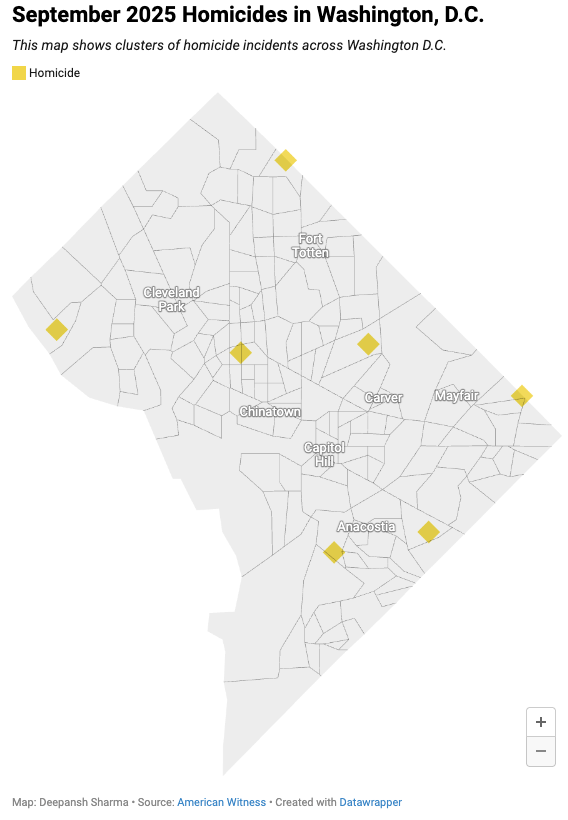
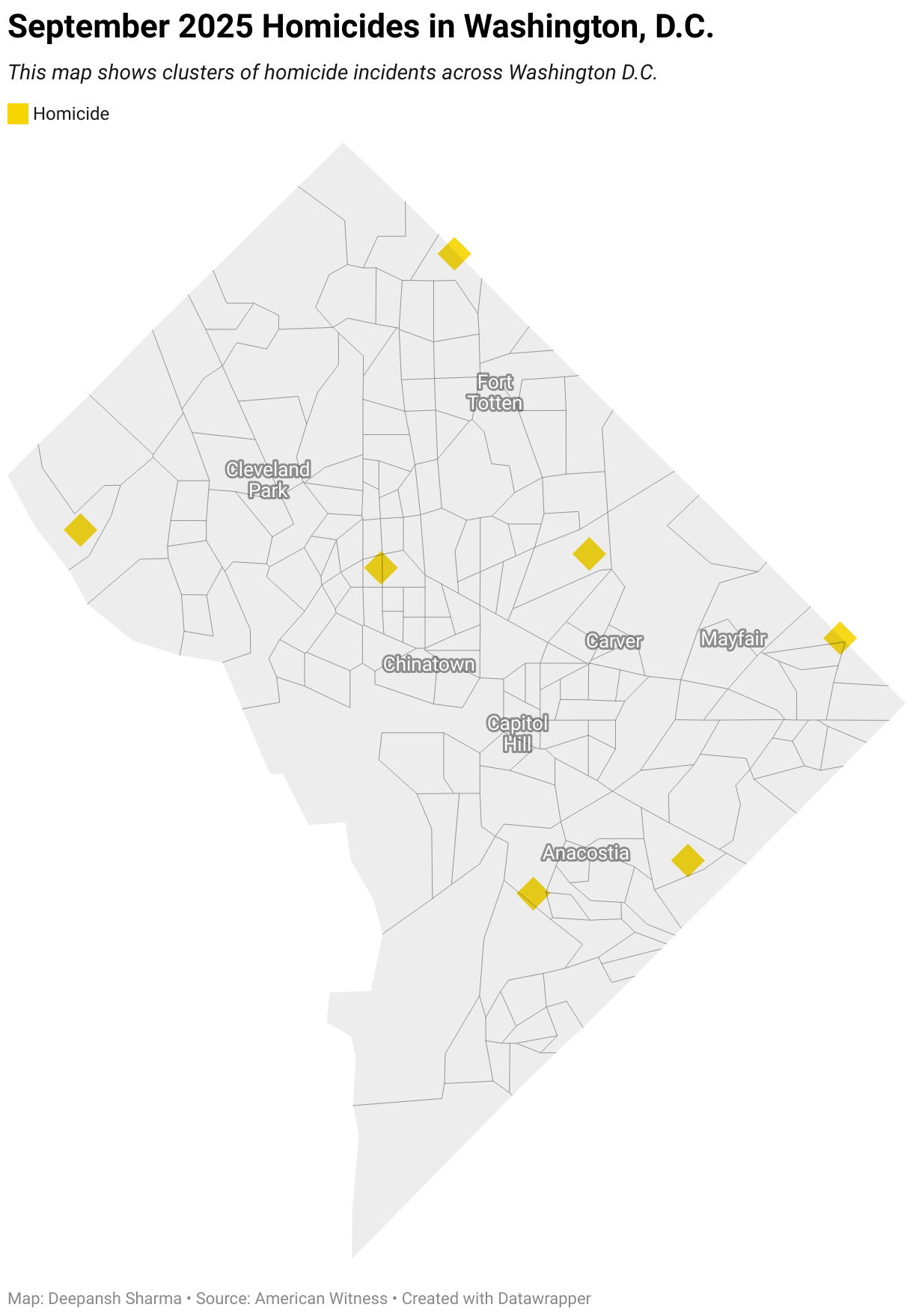
According to D.C. Witness data, among the seven reported homicide incidents and victims in September, three resulted from gun violence. A significant difference from August, when all five homicide incidents were fatal shootings. 

As of Oct. 15, of the seven incidents, The Metropolitan Police Department (MPD) has identified one suspect. 

Ricardo Botts, 37, is charged with second-degree murder while armed for his alleged involvement in the fatal stabbing of his mother, 66-year-old Pamela Botts on Sept. 21 on the 2100 block of 32nd Place, SE.

According to court documents, Ricardo’s grandmother reportedly heard a verbal argument and witnessed Ricardo standing over Pamela. The case is pending a preliminary hearing.

MPD has not identified suspects for the remaining six homicides.

According to MPD, one incident resulted from a large fight that occurred on Sept. 13 on the 2000 block of 14th Street, NW. In addition to the fatal stabbing of 34-year-old Jermaine Foster Jr., three victims sustained wounds during the fight.

MPD also reported an officer-involved shooting that resulted in the death of 31-year-old Jonathan Boruch on the 5100 block of Sherier Place, NW on Sept. 16. 

According to MPD, officers responded to a reported domestic disturbance where Bourch reportedly charged at the officers while armed with two knives. MPD officers reportedly fired one shot that fatally injured Boruch. The involved officers are on administrative leave and MPD’s Internal Affairs Bureau is investigating the incident. 

MPD is also investigating a fatal pedestrian crash that killed 40-year-old Angela Boston on Sept. 6 on the 1100 block of Eastern Avenue, NE. The black SUV that struck Boston immediately fled the scene.

MPD is currently offering a reward for information on the unsolved cases.

Shooting Suspect Waives Preliminary Hearing, Judge Denies Release

DC Superior Court Judge Heide Herrmann denied a shooting defendant’s request for release after he waived his right to a preliminary hearing on Oct. 15.

Xavier Anderson, 23, is charged with aggravated assault knowingly while armed and possession of a firearm during a crime of violence for his alleged involvement in a shooting that injured one on the 600 block of Galveston Street, SE on July 11. 

Thomas Lester, Anderson’s defense attorney, alerted the court of his intent to waive the preliminary hearing. 

Lester also requested for Anderson to be released with GPS monitoring, arguing that the GPS condition would allow the court to track his location. He said that because Anderson is homeless, he could stay at a local men’s shelter. 

The prosecution objected, arguing that Anderson should remain detained for the safety of the community. 

The prosecutor said footage of the shooting negates the argument that Anderson acted in self-defense, saying the weight of the evidence is strong. 

The prosecution highlighted Anderson’s past, noting he has a “pretty serious” misdemeanor case, violated a previous stay-away order, was convicted for a robbery in 2021, and has two bench warrants.

Lester contended that the actual information of the incident “doesn’t align with the [prosecution’s] argument.”

He said the cartridges that officers recovered from the incident did not match Anderson’s gun, instead matching the firearm of another individual allegedly involved.

Lester added that there was a verbal altercation minutes prior to the shooting

“There’s a greater question here than what the [prosecution] is indicating to the court,” Lester said.

He refuted the prosecution’s point about the stay-away order, saying previous prosecutors withdrew their hold upon discovering Anderson was not in the banned location. He maintained the prosecutor brought up the stay-away order to try to argue Anderson would not comply with any imposed release conditions. 

Lester said there is no evidence Anderson brandished a weapon and contended that he was compliant while being arrested. 

He argued that there were dissimilarities in describing the shooter because other witnesses detailed a person different than Anderson. He suggested that the complaining witness might have been overwhelmed by the incident and, therefore, pointed out the wrong person.  

Lester paraphrased what the other witnesses told officers, saying, “He didn’t do anything. He’s a different guy. He was just confused.”

Judge Herrmann remained concerned by the fact that Anderson illegally possessed a firearm, despite being prohibited, saying the weight of the case is “very strong.”

Judge Herrmann said that, even if the shooting did not happen, he would still be detained because of Anderson’s unlawful possession of a firearm. Therefore, she said she cannot ensure the safety of the community if he was released and he will thus remain detained.  

Parties are slated to reconvene Nov. 13.

Defense Claims Prosecution’s Shooting Case Has,’ a Flawed Foundation’

DC Superior Court Judge Neal Kravitz heard openings and witness testimony–including a victim–on the first day of a jury trial, Oct. 9, for a non-fatal shooting defendant. 

Daquawn Lubin, 30, is charged with with conspiracy while armed, two counts of assault with intent to kill while armed, aggravated assault knowingly while armed, unlawful possession of a firearm, carrying a pistol without a license outside home or business, assault with significant bodily injury while armed, and three counts of possession of a firearm during a crime of violence while armed and possession of a prohibited weapon for his alleged involvement in the non-fatal shooting of two victims. 

The incident occurred on the 4600 block of Benning Road, SE on July 24, 2023. 

In their opening, the prosecution claimed Lubin is one of two individuals responsible for shooting the victims, whose “lives changed forever”. 

According to the prosecution, Lubin and his ex-codefendant Johnathan Young, 35, were invited to an apartment complex by one of the victim’s now ex-girlfriends friends on July 24. The men were in the apartment for approximately 30 minutes before one of the victims arrived at the apartment and kicked the pair out. 

Consequently, the suspects returned allegedly armed, according to the prosecution. The shooters “unloaded” their magazines on the two victims after lying in wait in the parking lot of an apartment complex on Benning Road, alleged the prosecution.

In his opening the prosecutor admitted that he did not have any physical or forensic evidence to connect Lubin to the shootings. He went on to advise the jury that there is not just a single piece of evidence or witness that makes the case, it is “like a puzzle”. 

Defense attorney Kevin O’Sullivan insisted, “A structure built on a flawed foundation cannot stand”. He said that there are three reasons why Lubin should be found innocent, mainly that the prosecution failed to do a thorough investigation. 

According to O’Sullivan, Lubin does not fit the description of the shooter. He stated that there were two eyewitnesses who will not be called by the prosecution and not talked to by the lead detective in the case who identified the shooters as both having dreads. Lubin allegedly had short hair at the time of the incident.  

O’Sullivan alleged that the victims lied to police in original statements. One of the victims stated that the shooting was a result of a robbery gone wrong, when that was not the cause for the incident. Additionally, one of the victims was said to be carrying a weapon, violating the terms of his parole, but threw the weapon away on scene in order to not be found in possession of it by police on scene. 

Finally, O’Sullivan argued that the prosecution will not provide “one shred” of physical or forensic evidence connecting the defendant to this shooting. When a search warrant was executed on Lubin’s home, the clothing matching what the shooter was wearing was not recovered.

Additionally, a magazine and shell casings were found on scene. However, the defense says the shooter’s DNA would have been found on that magazine and the casings because the individual would have had to load the bullets. Lubin’s DNA was not found on any of these items, according to O’Sullivan.

The prosecution called one of the victims to testify. He used to date an individual who lived at the apartment complex–the violence occurred in the building’s parking lot.

He testified that on the day of the incident, he spoke to his girlfriend multiple times over the phone and felt something was wrong, so he visited her late in the afternoon. Upon arriving, he saw his girlfriend and four other guests, two of which were men. 

He said he had a private conversation with his girlfriend, which led to him forcefully telling the other guests to leave. He noted that they took some time to gather things, but that everyone left without complaint.

The victim said he invited his godfather to moderate the conversation with his girlfriend. Once the conversation concluded, he and his godfather left.

When the two got to the parking lot, the victim claimed he heard gunshots, but couldn’t tell how far away they were. He recalled a sharp sting in his “lower half” before not being able to feel anything. He also remembered bleeding. Sometime after, he testified, he woke up in a hospital bed, reporting that he had numerous stitches and staples down his leg.

While in the hospital, the victim spoke with detectives. They showed him an array of suspects and asked him if he recognized any. He highlighted one with long dreadlocks and no others. The man he identified was not Lubin.

The prosecution showed three different pieces of police footage to verify events with the victim. First, they showed him an image of him being found with blood-soaked clothing by a van. The victim confirmed that he was the man in the image.

Next, they showed two short videos of questions the police asked the victim when treating him. One was the police asking if he knew who shot him, and he said he didn’t. In the other, he stated that his family members were around. He clarified that the family he was referring to was his godfather and cousin.

The victim claimed that only one officer found him at the scene, but that his body and mind were still in shock, and that he remembered little of his interactions with the officer.

The victim noted that he had a gun during the incident. He stated he carries one for his protection, but that he wasn’t able to fire it during this incident and that he wished he did. He thought the incident may have gone differently if he could’ve used it. He said it “fell” and didn’t fire.

O’Sullivan asked the victim to confirm that he is a convicted felon and on probation for a case in Maryland. The victim confirmed, and clarified that he did not hide this when police found him. 

O’Sullivan asked if he was aware of the consequences if he were to be charged for having the gun. He said that he knew he wasn’t supposed to have it, but wasn’t aware of the exact consequences. 

The victim was granted statutory immunity for this case, but was warned of the charges he could face should the prosecution so desire including unlawful possession of a weapon, which, paired with the probation could result in his being sent to a federal prison.

During a short break, O’Sullivan highlighted a ballistics report from the incident, in which three shell casings were found around the victim and his car. Police also found a firearm nearby. Judge Kravitz agreed that the victim’s testimony was unclear, and that it seemed like the victim was not being completely truthful. 

O’Sullivan highlighted the discrepancy in the victim’s testimony in court and to the grand jury. While in court, he claimed that he didn’t fire and lost the gun, but he told the grand jury that he threw it away, which O’Sullivan presumed was due to his felony status. 

The victim did not clarify one way or the other, but noted that his primary thought during the incident was to get out of the area. He also assured that his godfather was not the one who shot the gun.

O’Sullivan asked if the victim yelled or threatened the other guests to get them to leave. He said he recalled saying “get the hell out,” but did not raise his voice or brandish the gun. He noted that the guests didn’t push to stay either, and that they left without confrontation.

The prosecution also called the victim’s now ex-girlfriend to testify. 

The witness identified, through prosecution’s exhibits, Lubin and Young as the men in security footage seen entering her apartment on July 24, 2023. She also testified that before this date she did not know Lubin, had not seen him before, and this was his first time entering her residence. 

When asked about the demeanor of the victim when he arrived at her apartment and kicked out the guests, she stated he was angry. She testified that although he was angry, she did not hear any profanity. yelling, and no one brandished a weapon. According to the witness, everyone left without issues. 

She testified that she heard gunshots as she attempted to leave her apartment. 

In cross examination by O’Sullivan, she stated that she did not see the shooters or the shooting occur. Furthermore, she did not see the injuries inflicted on either victim. 

The witness also stated that Lubin did not refuse or retaliate when he was kicked out of the apartment. 

Parties are slated to reconvene on Oct. 7.

Eyewitness Testifies ‘Bullets Started Flying’ in Homicide, Serial Shooting Trial

A witness recounted the day she was under fire in front of a murder trial jury before DC Superior Court Judge Rainey Brandt on Oct. 14.

Reginald Steele, 26, is charged with first-degree murder while armed, conspiracy, 10 counts of assault with intent to kill while armed, 11 counts of possession of a firearm during a crime of violence, four counts of carrying a pistol without a license, two counts of tampering with physical evidence, and five counts of possession of an unregistered firearm. 

The charges are in connection to his alleged involvement in four shootings, including the fatal shooting of 13-year-old Malachi Lukes, at the 600 block of S Street, NW, on March 1, 2020. Another individual sustained injuries during the incident. 

Steele is also linked to a non-fatal shooting on March 1, 2020 at the unit block of Channing Street, NE, and a non-fatal shooting on Feb. 24, 2020 at the 1700 block of Ninth Street, NW. No individuals were injured on Channing Street, and three individuals were injured on Ninth Street. 

Additionally, Steele faces charges for his alleged involvement in a non-fatal shooting on Feb. 22, 2020 at the 700 block of Farragut Street, NW. No individuals sustained injuries. 

A witness who was present at the Farragut Street shooting explained her experience, and the moments leading up to the shooting. 

The witness stated that she had been sitting on the front porch of her mother’s home with her boyfriend and a friend–it was her grandmother’s birthday and she was home to celebrate. 

The witness recounted seeing a gray Kia pull up to the front of the house. She found it odd that there were young people in the car, as they didn’t typically frequent the area.

Referring to previous grand jury testimony given, she described the car as having two men and two women inside, with one of the men yelling in an aggressive tone before hurriedly driving away. 

“At any time did you threaten the people in the car?,” the prosecutor asked. “Did anyone else threaten people in the car? Did anyone point a weapon at them?,” prosecutors continued. The witness answered no to all three questions. 

The witness thought the incident was over, so the group continued to gather on the front porch, with the witness describing the environment as “chill and quiet”. 

However, as the witness stated that about five minutes later, she saw two men approaching on foot, wearing the same colored shirts that she saw the men in the car wearing– gray and green. 

The witness said she thought they were coming to fight. She described turning to her boyfriend, who testified on Oct. 9 about the same incident, and telling him not to fight the men. 

Then, “bullets started flying toward us,” the witness stated. “I didn’t see it, but I heard it”.

The witness believed one of the females in the car was her neighbor, who she described as having had a previous altercation with the witness’ younger sister. The witness wasn’t entirely certain it was her, but felt fairly confident it was. 

Defense attorney Gemma Stevens asked the witness if there were any injuries sustained, or medical attention needed– the witness said there wasn’t. 

A supervisor in the firearm registration branch at the Metropolitan Police Department (MPD) was called to the stand. Prosecutors confirmed with the witness that Steele had no conceal carry license, or any firearms registered in his name at the time of the incidents. 

Trial is set to reconvene on Oct. 15.

Probable Cause Found in Sneaker Store Homicide

Detective testimony and surveillance footage provided evidence of probable cause in a homicide case before DC Superior Court Judge Michael Ryan on Oct. 8.

Andre Townsend, 31, is charged with second-degree murder while armed for his alleged involvement in the shooting death of Derrick Howard, 39, on the 3000 block of Martin Luther King Jr. Avenue, SE on March 18.

The prosecution called the investigating detective to testify about surveillance footage he collected of the incident. He stated that a man he identified as Townsend can be seen sticking his arm up as shots are heard and the victim is seen falling to the ground. The men were gathered outside a shoe store for a release of a new item new item, and a dispute between a group including the victim and a group involving the defendant ensued, according to the detective.

The witness claimed that he identified the shooter by presenting a photo array and showing Instagram pictures to witnesses. He stated that three different people independently identified Townsend as the shooter. He also said that he interviewed the defendant twice, both before and after his arrest, about the shooting and his answers were not consistent each time.

Cross examination confirmed that Townsend could not be identified from the video directly. He also revealed, as was also in the arrest warrant, that one of the witnesses admitted to the detective that he had a firearm as well at the time of the incident but did not fire it.

Judge Ryan ultimately decided that there was probable cause to move forward on the charge of second-degree while armed because of the testimony of the witness, the identification of the shooter by multiple witnesses, and cell site data putting Townsend in the area of the shooting.

Court is set to reconvene for a felony status conference Nov. 21 before Judge Rainey Brandt

Jury Acquits Shooting Suspect on Most Charges

A jury rendered a not guilty verdict for the primary charges in a non-fatal shooting before DC Superior Court Judge Judith Pipe on Oct. 8. 

Dominick Jackson, 41, was originally charged with assault with a dangerous weapon, assault with significant bodily injury while armed, aggravated assault knowingly while armed, possession of a firearm during a crime of violence, unlawful possession of a firearm in an intrafamily offense, and obstructing justice for his alleged involvement in a shooting that occurred on Nov. 20, 2022, on the 700 block of 12th Street, NE.

However, the jury acquitted Jackson of all charges, except obstructing justice.  

In light of the verdict, Judge Pipe allowed Jackson’s GPS monitor to be removed. 

Parties are slated to reconvene to see if the prosecution decides to refile the case on Dec. 12. 

Stabbing Defendant Waives Right to Preliminary Hearing

A stabbing defendant waived his right to a preliminary hearing on Oct. 8 before DC Superior Court Judge Heide Herrmann.

Chad Hawthorne, 44, is charged with assault with a dangerous weapon for his alleged involvement in the stabbing of an inmate on July 25 at the DC Jail on the 1900 block of D Street, SE. 

According to court documents, video surveillance and body camera footage showed an individual, identified as Hawthorne, approach the victim, who was being escorted by an officer, and stab him several times with a sharp metal object. The victim sustained several stab wounds. 

Tammy Thom, Hawthorne’s attorney, alerted the court of his intent to waive the preliminary hearing of the evidence in the case.

The court ruled Hawthorne should remain detained. 

Parties are slated to reconvene Nov. 7. 

Defense Alleges Shooting Evidence is Unconstitutional

Parties discussed evidence that reportedly violated a shooting defendant’s constitutional rights before DC Superior Court Judge Michael Ryan on Oct. 10. 

Anthony Goncalves, 53, is charged with assault with intent to kill while armed against a minor, aggravated assault knowingly while armed against a minor, two counts of possession of a firearm during a crime of violence, and unlawful possession of a firearm with a prior conviction. The charges stem from his alleged involvement in a non-fatal shooting on Nov. 29, 2023 on the 3900 block of Minnesota Avenue, NE. A 14-year-old boy sustained nine gunshot wounds. 

At the status hearing, Goncalves’ attorney, James Brockway, informed Judge Ryan that the primary issue in the case was a defense motion to suppress evidence. Filed on Sept. 11, the motion requested evidence obtained as a result of electronic monitoring by Court Services and Offender Supervision Agency (CSOSA) be suppressed. 

According to the defense motion, while Goncalves was on parole for a prior offense in November 2023, CSOSA ordered him to wear a GPS monitor without legal authority. Brockway claimed after the Metropolitan Police Department (MPD) received the GPS data from CSOSA, they designated Goncalves as a suspect in the case. MPD then reportedly used the GPS data as a basis to obtain a search warrant and collect additional evidence against Goncalves. 

Brockway asserted the GPS monitoring by CSOSA violated Goncalves Fourth Amendment right against unreasonable searches and requested to exclude all evidence obtained as a result.

The prosecution requested more time to respond to the motion and indicated there might be an argument for some of the evidence to be admitted, despite it being illegally obtained. 

Judge Ryan granted the prosecutor’s request and parties are scheduled to reconvene to discuss the issue on Nov. 21.

Trial Delayed as Carjacking Defendant Awaits New Jury

A carjacking defendant’s trial was rescheduled by DC Superior Court Judge Errol Arthur on Oct. 8, despite a jury already having been selected. 

Raysean Brown, 29, is charged with three counts of assault with a dangerous weapon, two counts of threat to kidnap or injure a person, armed carjacking, four counts of possession of a firearm during a crime of violence, destruction of property $1000 or more, two counts of reckless driving, fleeing a law enforcement officer, and unauthorized use of a vehicle.

The charges are in connection to Brown’s alleged involvement in an armed carjacking that occurred on the 5000 block of Georgia Avenue, NW. No injuries were reported. 

A jury was selected on Oct. 7 for Brown’s trial, and multiple witnesses were also prepared to testify. However, after discussions with defense attorney Joseph McCoy and prosecutors, Judge Arthur announced that the trial would be rescheduled to Nov. 10 due to the time when a witness would be available.

Judge Arthur thanked and excused the jury from service for the day– an entirely new jury will be selected for the new trial date. 

Due to the trial delay, McCoy requested for the release of Brown, which Judge Arthur denied on the basis of the severity of charges in Brown’s case.

Parties are set to reconvene for the new trial on Nov. 10.  

Jail Stabbing Defendant Pleads Not Guilty, Seeks Additional Evidence

A stabbing defendant pleaded not guilty and asked the prosecution to share any body-camera footage from the incident in a hearing before DC Superior Court Judge Carmen McLean on Oct. 3.

Ovid Gabriel, 20, is charged with assault with significant bodily injury while armed, assault with a dangerous weapon, and the unlawful possession of contraband in a penal institution for his alleged involvement in a stabbing incident at the DC Jail on the 1900 block of D Street, SE that wounded one individual on March 28.

During the hearing, Gabriel pleaded not guilty to all charges and asserted his constitutional rights, including the right to a speedy trial. 

Gabriel also requested that the prosecution comply with its Brady and Rule 16 obligations, which require the prosecution to disclose certain evidence to the defense, including any evidence that might be exculpatory, and share body-worn camera footage obtained from correctional officers, or take all reasonable steps to retrieve and disclose the footage.

In response, the prosecution maintained that it had disclosed all relevant and necessary case materials that it had. The prosecution also noted that it was concerned that the case was being unnecessarily prolonged as a result of the multiple Rule 16 request hearings.

Judge McLean agreed that the hearings were taking additional time, but that it was entirely appropriate for Gabriel to request Rule 16 and Brady compliance. She stated that the additional hearings were not unduly prolonging the case. The prosecution acknowledged the finding, but said it may have to withdraw a favorable plea offer it had previously extended if the hearings continued for much longer. The offer’s terms were not listed.

The defendant also asked to modify his detention, telling the court that he was shackled at all times. Stand-by attorney Raymond Jones argued that Gabriel was far from the most dangerous inmate in the jail and that the excessive shackling was unnecessary.

Judge McLean told Gabriel that it was “not [her] place” to get involved with the jail and that she did not have the power to change jail relief conditions. 

Parties are slated to reconvene on Nov. 18.

Carjacking Defendant Pleads Guilty, Released Without GPS Monitor

A carjacking defendant pleaded guilty and was released without GPS monitoring in a hearing before DC Superior Court Judge Carmen McLean on Oct. 3.

Shannara Macku, 38, was originally charged with carjacking and assaulting a law enforcement officer for her involvement in a carjacking on the 2400 block of 18th Street, NW, on Oct. 19, 2024.

Macku entered an agreement with the prosecution, which required her to plead guilty to destruction of property, first-degree theft, and unauthorized use of a motor vehicle. In exchange, the prosecution agreed not to seek an indictment and dismiss all other charges, as well as two misdemeanor cases.

Defense attorney Destiny Fullwood-Singh asked that Macku’s GPS monitor be removed. Judge McLean responded that Macku’s compliance has “improved in every way” since her release from jail, and that she has gotten back on track. As such, Judge McLean agreed to remove Macku from GPS monitoring.

The prosecution objected, stating that Macku had committed the carjacking while on release from other cases. Judge McLean acknowledged the concern but said that Macku had been fully compliant with the release conditions of this case.

Parties are slated to reconvene on Dec. 12 for sentencing.

Closing Arguments After Victim Questions Shooter’s Identity in Love Triangle

Closing arguments commenced after the defense introduced a video showing the victim involved in a love triange allegedly naming a different potential shooter before DC Superior Court Judge Judith Pipe on Oct. 7.

Dominick Jackson, 41, is charged with assault with a dangerous weapon, possession of a firearm during a crime of violence, assault with significant bodily injury while armed, aggravated assault knowingly while armed, unlawful possession of a firearm, and obstruction of justice for his alleged involvement in a shooting that hospitalized an individual at the 700 block of 12th Street, NE, on Nov. 20, 2022.

The trial continued with Jackson’s attorney, Kevin Robertson, presenting a video of an interaction the victim had with an officer on their ambulance ride to the hospital. In the sequence, the officer asked the victim whether they could identify his assailant. In response, the victim seems to mention the name “Foster” before quickly changing it to “Jackson.”

The prosecutor started closing arguments, stating that the events that happened were straightforward. Jackson threatened to “blow [the victim’s] brains out” and tried exactly do do so. 

According to the prosecution, Jackson was in a complicated love triangle with the victim and a woman. The prosecution claimed that after Jackson pulled up to the woman’s house, and when she turned away, he shot the victim’s car four times. As a result, the victim was severely wounded, experienced significant blood loss, which resulted in a month-long hospitalization, the prosecution recalled.

Following the incident, the prosecution claimed that Jackson threatened the woman about her involvement in the case, stating, “snitches be bitches, bitches end up in ditches.” The prosecutor mentioned that the witness was terrified to testify, thinking that she would “be six feet under” because of her involvement in the case.

Robertson responded by stating that there were crucial moments in the trial that the prosecution was ignoring.

According to Robertson, when the woman testified in trial, she was asked who she was in a relationship with. After hesitation, she stated she was married to an individual named “Foster.” Robertson insisted he could have been the one to commit the shooting. 

Robertson questioned the woman’s credibility, stating that she and the victim both mentioned Foster in statements to police and during trial.

Robertson also insisted the woman was not afraid to testify, but rather afraid to tell the truth, because Foster could retaliate.  According to Robertson, this alluded to the fact that there was some “real truth” other than that Jackson shot the victim that night.

The claim was that when the witness was in a difficult spot due to the shooting and heard that the victim mentioned Jackson’s name as the shooter, the prosecutor jumped at the opportunity to put the blame on Jackson.

Robertson emphasized inconsistencies in the testimony and timeline, attempting to cast doubt on the credibility of the victim’s account. 

Robertson challenged a protective order filed by the victim, portraying it as a tactical move rather than a genuine plea for protection, claiming it was used to gain control in a volatile situation. The defense argued that Jackso had no clear motive and that the state’s theory relied too heavily on assumptions and emotional testimony. 

In response, the prosecution argued that it was a “messy, toxic love triangle.” Rather than distancing itself from the complicated dynamics between the individuals involved, the prosecution leaned into them, arguing that the buildup of “tension, betrayal, and aggression” inevitably led to the violent outcome.

They dismissed the defense’s narrative as a deliberate illusion—an attempt to redirect focus away from clear identifications and credible threats. According to the prosecution, the first name the victim spoke was that of the defendant, and this was repeated more than once. They pushed back against the idea that drugs or confusion were responsible, emphasizing consistency of the identification.

While the defense framed the forensic evidence and witness credibility as distractions, the prosecution insisted the truth was simple: the defendant acted out violently, and two people placed him at the scene. 
The prosecution closed with a reminder that “the government does not choose its victims, the defendant did.” The jury left and started deliberating. 

Parties are slated to reconvene when the jury reaches a verdict. 

Homicide Defendant Accepts Plea Deal After Confessing to Murder on Social Media

A homicide defendant accepted a plea deal before DC Superior Court Judge Todd Edelman on Oct. 10. 

Shaun Brown, 25, was originally charged with first-degree premeditated murder while armed, aggravated assault knowingly while armed, six counts of assault with intent to kill while armed, and eight counts of possession of a firearm during a crime of violence, for his involvement in the fatal shooting of 47-year-old Dametrics Evans on Oct. 25, 2021 on the 4900 block of G Street, SE. Another individual sustained life-threatening injuries during the incident. 

During the hearing, Michael Bruckheim, Brown’s attorney, alerted Judge Edelman of his intent to accept a plea deal, which required him to plead guilty to voluntary manslaughter while armed and assault with a dangerous weapon in exchange for the prosecution dismissing all other charges. 

Through the deal, parties agreed to a sentencing range of ten-to-12-and-a-half years of imprisonment. 

According to the prosecution, had the case gone to trial, they would have proven beyond a reasonable doubt that on Oct. 25, 2021, there was a group of individuals hanging around in the hallway of an apartment building where Brown was congregating with other people. As the group walked past the door to the apartment with Brown and his friends, Brown extended his hand out of the door frame and shot at the group, fatally injuring Evans, and seriously injuring a man. 

The case was previously dismissed, but was reopened after Brown confessed to the murder on social media in February 2023.

The prosecution claimed Brown’s actions were voluntary and on purpose. 

Parties are slated to reconvene for sentencing on Dec. 19. 

Fratricide Defendant Pleads Not Guilty at Arraignment 

A homicide defendant pleaded not guilty to all charges in his brother’s murder before DC Superior Court Judge Todd Edelman on Oct. 10. 

Lamar Odoms, 24, is charged with second-degree murder while armed, possession of a firearm during a crime of violence and carrying a pistol without a license for his alleged involvement in the fatal shooting of his brother, 25-year-old Mark Odoms, on Dec. 5, 2024 on the 2700 block of Wade Road, SE. 

According to court documents, a witness told officers from the Metropolitan Police Department (MPD) they heard and saw the Odoms brothers fighting in a hallway before Lamar allegedly stood over Mark and shot him. 

During the hearing, Gemma Stevens, Odoms’ attorney, alerted Judge Edelman of his intent to plead not guilty to all charges, and asserted his constitutional rights, including the right to a speedy trial. 

Parties are slated to reconvene Oct. 24.