Search Icon Search site

Search

Myshawn Allen ordered held without bail


A confrontation broke out in the courtroom as murder suspect Myshawn Allen was arraigned Friday afternoon on charges he killed Tyronn Hodges.

During the arraignment, a man whistled at the suspect while he stood at the front of the courtroom. A fight broke out between multiple parties in the courtroom, which was broken up by U.S. Marshals.

Allen was arrested and charged with second-degree murder for Hodges’ murder. He had previously been charged with assault with a dangerous weapon in 2015.

On Wednesday, police heard gunshots while on patrol and were approached by a woman, suffering from multiple gunshot wounds. They then found Hodges’ body in a car nearby, riddled with gunshots. Hodges was pronounced dead at the scene.

Allen is being held without bond until his next scheduled appearance on February 21.

Documents: Dejuan Etheredge charging documents

Dejuan Etheredge is pending trial for the alleged murder of Uyer Hooper.

[documentcloud url=”http://www.documentcloud.org/documents/3442674-Dejuan-Etheredge-warrant-affidavit.html”]

Potential delay in David Simmons’ murder trial

Almost two years after the murder of 32-year-old David Simmons the trial for his murder has yet to begin, and more delays may be on the horizon.

Simmons was killed in March 2015 during a shooting on the 2300 block of Hartford St., SE. When police responded, they found both Simmons and another man suffering from gunshot wounds. They were both brought to a nearby hospital where Simmons succumbed to his injuries.

According to police, Rashad Allen, 33, is responsible for Simmons death. Allen is currently being held without bail as he faces second-degree-murder while armed charges.

At a status hearing Thursday, Judge Lynn Leibovitz asked both the defense counsel and the prosecutor if they were ready for trial. The prosecutor was quick to agree and went on to explain his time frame consisting of a three day argument with between fifteen and nineteen witnesses.

The defense attorneys were not in the same position, and instead argued for pushing the trial date.

According to April Downs, one of Allens’ attorneys, a new expert was assigned to go over the evidence. After testing shell casings found at the crime scene, the new expert came to different conclusions than previously noted.

In addition, Downs argued for a blood swab that was found at the crime scene to be tested, though it was deemed irrelevant previously.

Judge Leibovitz granted a continuance for tomorrow at noon in order for Downs to explain why the new conclusions of the shell casings and the blood swab warrant a delay in the trial date.


This story has been updated. 

GPS Tracker puts suspect at the scene of Waliyatou Amadou’s murder

A GPS ankle bracelet placed murder suspect Deangelo Thorne, 27, at the scene where the body of 23-year-old Waliyatou Amadou was found, according to a warrant for his arrest.

Thorne is currently being held without bond as he faces second-degree murder charges.

Around 8 p.m. on Jan. 8., Amadou’s body was found inside the apartment building at 1424 W Street after police responded to a report of an unconscious woman. Police found Amadou lying face down on the ground near a basement laundry room, with multiple stab wounds to her torso. Amadou was brought to a local hospital where the coroner ruled her cause of death the result of five torso stab wounds.

According to surveillance footage described in the warrant, a man wearing dark clothing, donning a jacket with a small light colored emblem on the upper left chest area, is seen walking in the alleyway behind the building where Amadou was killed. In the same video, Amadou can be seen carrying a backpack.

Another camera from the inside of the building showed Amadou and the man in dark clothing meet in a hallway. Together they enter an open door in the hallway and exit less than minute later.

Once back in the hallway, Amadou begins walking towards the man until his back hits an exit to the building. Amadou appears to hit the man though it’s unclear if she makes contact, and the man retaliates by pushing Amadou.

The man appears to hit Amadou multiple times in the torso area. The man stops his attack, and Amadou falls face first to the ground. The man grabs something from the ground then flees the building to the nearby alleyway.

At the time of the murder, Thorne was wearing a GPS monitor, for drug-related charges. The GPS placed Thorne in the alleyway behind the building where the murder occurred. The report also indicates that Thorne’s tracker left the incident location at the same time the man in the video fled the scene.

The day after the murder, Thorne told his probation officer that someone other than him had cut off his ankle monitor the day before the murder. The police found the tracker at the house of one of Thorne’s relatives, a mile away from his residence.

On Jan. 2, days before the murder, Thorne was stopped for an unrelated incident and at the time of the stop his description matched the man described in the video: a man wearing dark clothing with a emblem on the chest of his jacket. According to police, Thorne was carrying a knife with a gold handle which was returned to him at the end of the stop.

According to another witness interview, on Jan. 3 Thorne attempted to cut them with the same knife described previously. According to the interview, the witness and Amadou confronted Thorne about whether he sexually assaulted or had consensual sex with Amadou when Thorne pulled the gold-handed knife out.

The same witness was brought into the station after the murder was able to identify Thorne as the person who tried to cut them.

Thorne is expected in court Feb. 7 for a preliminary hearing.

Victim Uyer Hooper identified suspect before he died, prosecution says

With one of his last breaths, Uyer Hooper identified his killer, prosecutors said during a hearing before the murder trial begins for the accused.

The case against Dejuan Etheredge is expected to head to trial Feb. 10 and last through Feb. 13.

According to police, on Sept. 6, 2015, at approximately 3:30 a.m. Hooper was one of two men allegedly shot by Etheredge.  Etheredge and the other victim was taken to a local hospital.  Hooper was declared dead at the hospital and the other man survived.

On Wednesday, the prosecutor said they plan to call detectives as witnesses to discuss what was said between them and the victim.

On Tuesday, the government argued that suspect’s drug dealings were his motive leading him to kill the victim. The judge dismissed the argument and said the suspect’s criminal profile had no relevance.

Police identify victim, suspect in Burrville shooting

Police have identified 25-year-old Tyronn Julius Hodges as the victim of a fatal shooting on 900 block of Eastern Ave., NE.

According to a police spokesperson, police were in the Burrville area last night around 7 p.m. when they heard gunshots. Upon police arrival, a woman approached them suffering from multiple gunshot wounds. Police then located Hodges’ gunshot riddled body in a car.

The woman was brought to a nearby hospital with non-life threatening injuries. Hodges was pronounced dead on the scene.

Police arrested Myshawn Dondre Allen, 23, on the scene and charged him with first-degree-murder while armed and assault with intent to kill.

Uyer Hooper was killed by friend in argument over drugs, warrant says


The man charged with the murder of Uyer Hooper allegedly killed his friend in an argument over drugs, according to the warrant for his arrest.

Dejuan Etheredge was charged with first-degree-murder while armed for the fatal shooting of Hooper on September 6. Hooper and another man were shot, but Hooper had a gunshot wound to the neck and was pronounced dead at the hospital at 3:54 a.m. At the time of the warrant, a medical examiner had not yet completed an autopsy.

Police discovered that Etheredge and Hooper had been long-time friends, who had a dispute about drugs in the past. According to the warrant, a witness saw the suspect, later identified as Hooper, speed away in a loaner vehicle. Later, police found the suspect who denied any involvement. After police obtained a warrant to search a dwelling attached to Hooper’s, they discovered a gun and drug paraphernalia.

Hooper’s trial is ongoing.

January homicides follow trend of last two years

The nation’s capital didn’t tally it’s first homicide until six days after the new year, but the numbers quickly added up to eight and followed trends for the past two years.

The first homicide of the year actually began in October of last year, when Richard Lewis, 57, was assaulted outside of Union Station. Lewis succumbed to his injuries on Jan. 6, making his death the first homicide of 2017.

The suspect, 56-year-old Victor Purdie, is currently being held without bond. In the warrant detailing Purdie’s arrest, the suspect admitted to assaulting Lewis and alleged the deceased antagonized him.

Lewis is one of two January victims that police have identified a suspect.

Waliyatou Amado, 23, was stabbed to death and her body left on the floor in a building on W Street on Jan. 8. Amado’s alleged murderer, Deangelo Thorne, 27, was caught on surveillance footage and ultimately charged with second-degree murder while armed.

Police have yet to identify a suspect in an additional six January homicides:

On Jan. 7, Devin Hall, 23, was found fatally shot inside a parked car in Congress Heights with no suspect in sight.

On Martin Luther King Day, Vivian Marrow, 68, was on her way to the grocery store in her motorized wheelchair when she was shot. Interim Police Chief Peter Newsham held a press conference the day after Marrow’s death urging community members to come forward with any information pertaining to the alleged murder. Police are currently looking for a person of interest, a left-handed black male with a slim build, who was featured in surveillance footage that captured the suspected murder.

A double shooting in the early morning of Jan. 17 left Ronell Reaves, 22, dead on 600 block of 14th Pl., NE.

Reaves is the youngest victim of January 2016, while Marrow caps the age range at 68 years.

Anthony Irving, 44, was fatally shot in the evening of Jan. 17 on 4400 block of Hayes St., NE. Upon police arrival, Irving was found suffering from multiple gunshot wounds and died shortly after succumbing to his injuries.

On Jan. 24 police found Willie Starkey, 35, dead from gunshot wounds to the head and neck outside of a Benning Road laundromat. Police have circulated a video of a suspect, described as a black individual, between 5’8” and 6’2” tall, weighing between 160-200 pounds.

January’s final homicide occurred on the evening of the 29th. Police found 34-year-old Wilson Agbebaku on 200 block of 52 St., NE suffering from multiple gunshot wounds. Agbebaku died shortly after he arrived at the local hospital.

Of the eight murders, six were the result of shootings. While looking at the month’s total, five homicides occurred in the Northeast quadrant of the city, two in Southeast, and the remaining homicide took place in Northwest.

In 2015 and 2016, D.C. saw 9 murders in January.

This January, the average victim was a 35-year-old black male.

[infogram id=”1a836d0e-0256-481f-9f8d-0f51455d7787″ prefix=”IxT” format=”interactive” title=”Monthly Recap: January”]

Judge rules prosecution cannot call several witnesses in Uyer Hooper murder trial


A judge on Tuesday said a murder suspect’s former drug dealings with a victim is not enough to prove motive, and denied to allow several witnesses give testimony in a trial.

Dejuan Etheredge was indicted on seven charges, including murder and assault with intent to kill, and has pleaded not guilty.

According to police, at around 3:30 a.m. Sept. 6, 2015, Uyer Hooper, one of two men allegedly shot by Etheredge, was found in the 6400 block of 7th St. NW suffering from gunshot wounds. He was taken to the hospital and pronounced dead. The other man was taken to the hospital and survived.

A prosecutor said they planned to present witnesses who would testify that Etheredge used to give Hooper drugs to sell on the street. The day of the shooting, the prosecutor said, witnesses say Hooper was purchasing drugs from another person to re-sell, which led Etheredge to fatally shoot Hooper.

The judge said the defendant’s status as an alleged drug dealer and his relationship to the victim was not enough to prove motive, and will not allow those witnesses to testify in front of the jury.

The case is set to resume Wednesday.


Lawyers allude to competency defense in homicide caused by Metrobus hijacking

An attorney for Keith Loving, who allegedly crashed into a man after hijacking a city bus, alluded on Tuesday that the competency of his client could be called into question as the case moves forward.

According to police, in May 2016, Loving, 30, hijacked a metro bus and and crashed it into a gas station on Nannie Helen Burroughs Avenue. During the crash, Loving struck Payne, who was an employee at the gas station. Payne died after succumbing to his injuries sustained during the collision.

Loving is currently being held without bond as he faces second-degree-murder charges.

A status hearing was called today because the defense failed to release all of Loving’s mental health records from St. Elizabeth Hospital.

According to Loving’s lawyers, they didn’t release the records in order to maintain their client’s right to privacy. The defense said the records may bring to light previous criminal activities Loving was involved in while at St. Elizabeth’s.

A part of the defense’s argument was based on allegations that St. Elizabeth’s records contained notes obtained while staff eavesdropped on Loving’s meetings with his lawyers, therefore breaching attorney/client privilege.

In response, the prosecution said their sole focus is determining Loving’s competency. All of Loving’s records are vital in providing context to weigh whether or not Loving is competent in his actions, they said.

Judge Jose Lopez ruled in favor of the prosecution and called for the release of all of Loving’s St. Elizabeth’s records. Judge Lopez also called for the redaction of all notes relating to dialogue between the defense and Loving, though he left it up to the prosecution and defense to figure out the method by which they would redact information.

The case is set to continue on April 7 for a mental observation hearing.

Police ask community for help in locating Elliot Starks

Police are again asking for the public’s help in the search for 34-year-old Elliot Avery Starks.

Starks is wanted for the alleged murder of 40-year-old Antina Cinette Pratt. Pratt was found stabbed to death in November 2016 after police responded to a report of an unconscious female. Pratt was found dead on the scene in the 2600 block of Pomeroy Road, SE.

Starks has a warrant for his arrest for first-degree-murder while armed.
According to police, Starks is 5’ 11” tall, weighs 165 pounds, has brown eyes, a medium complexion and black hair that appears to be balding. Starks is considered armed and dangerous.


Elliot Avery Starks

DC’s Lock-Up Problem: Murder suspects wait up to two years for their day in court

Recently, the Washington Post made waves by reporting that a D.C. criminal release program is putting dangerous criminals back on the streets to wreak violent mayhem on the city.

But while there have been truly tragic incidents, the reality is that those cases are rare– and even more rare when looking at the most heinous of crimes: murder.

Of those arrested and charged with murder, only five– four of them women, involved in domestic incidents, were released after initial hearings. The chance of someone charged with a violent crime and being released is slim, as D.C.’s court system did away with a system of bail, where defendants can put down money to get out of jail. So those charged with crimes are either held behind bars or released under certain conditions like house arrest or electronic tracking. But it is rare for violent offenders to be released.

It is what happens to those held rather than those released that is the real story.

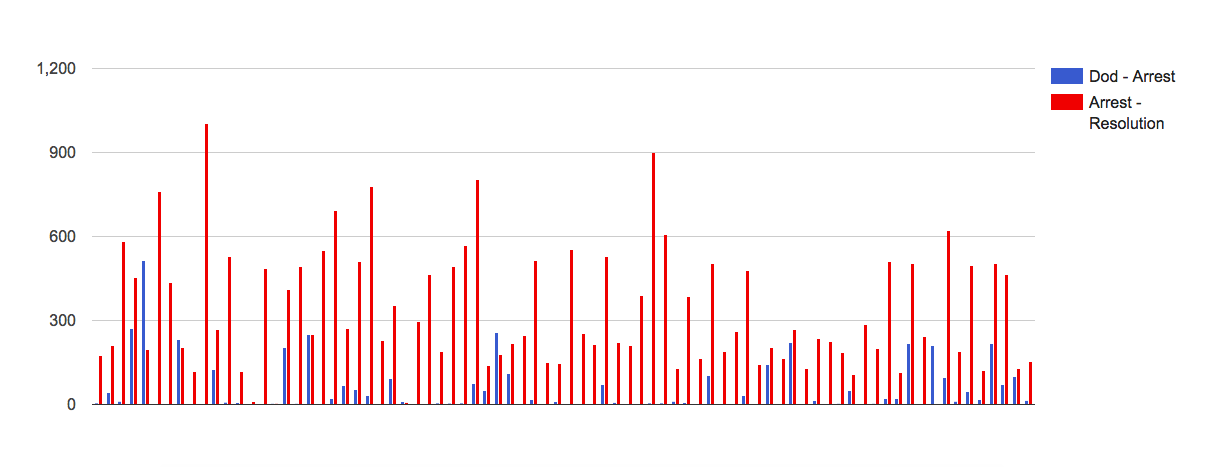
D.C. Witness’ review of data, and attendance at court hearings reveals that 165 men, women and juveniles were arrested and charged with murder between  2015 and 2016. Of those only 33 have had their cases resolved. That means 133, or over ¾ of those arrested over the last two years are sitting in jail – some for as long as a two years.

Equally importantly, of the 297 homicides in 2015 and 2016, more than half are unsolved (164) meaning you have a better than 50 percent chance of getting away with murder in DC.

The reality is that nobody, not even those responsible, are paying much attention to what happens once someone has been charged and locked up.

Of those who were charged since 2015, only one made it to trial and was acquitted, after he had spent 493 days in jail. The other 32 resolved cases were settled with a plea deal– ranging from settled charges of murder to assault, with the highest sentence handed down being 26 years. If those accused are not willing to accept a plea deal, the process all but comes to a halt.

Beyond the question of how justice is ultimately doled out, an unanswered question for DC is how holding so many suspects for up to 2 years without trial can be reconciled with sixth amendment that guarantees a fair and speedy one.

D.C. Witness has tracked those charged with murder in the city since the start of 2015 and found that as of midnight January 1, 2017, 149 men and women charged with murder had been waiting an average of 303 days for their case to be resolved. Of those suspects, 47 are pending trial, 62 are pending on some other matters before trial,  and others are waiting on on other issues, such as mental health evaluations or stays in St. Elizabeth’s Hospital, which drag out the average. There are 8 suspects who are pending sentencing, all who face mandatory jail time. Their convictions range from murder to assault.

While waiting for an indictment, or watching as a case is rescheduled or delayed while both sides wait for information and evidence, the judge often checks in on how much longer a case has– before the “180 day rule” goes into effect. Because all felony cases head to a grand jury in D.C., the law says the government has 180 days to indict. After that, it is often both sides, the government and the defense attorney who argue for delays in moving to trial.

Marc Schindler, Executive Director of the Justice Policy Institute argues that this slow process may not always be a bad thing as in terms of justice because it allows for a more thorough process. That’s because D.C.’s public defender service, which has some of the lowest caseloads around the country,  only takes on the most serious crimes and  has a reputation for being one of the best public defender offices around the country. Coupled with a strange federal/local system, where it is the federal District Attorney’s office arguing murder cases, you have high-level attorneys on both sides and a DC murder trial becomes a battle of legal power houses.

“Just like on the defense side, where we have a really well-resourced, very professional and capable team of defense lawyers, you also have prosecutors in the U.S. Attorney’s Office who are well-resourced…and I would say by virtue of quality and ability, at the very top of what you’d see from a local prosecutor’s office….so here, you really have a true adversarial system.”

So as the legal “A” teams gird for battle, those charged sit in jail waiting with no one to argue for a quick resolution.

But Schindler also added  a caveat– it’s hard to judge the D.C. system when you don’t know how it shapes up against other systems. And no one is apparently tracking what is happening between charging and judicial resolution on a national scale for murder or any other crimes. While the city has been lauded and applauded for abolishing the bail system as a way to not release the rich and incarcerate the poor, no D.C. organizations are paying attention to these pre-trial detention times, neither justice advocacy organizations nor the DC government itself.

When D.C. Witness was looking into the story, not a single organization knew nor was interested in these wait times, that entail justice delayed and denied. The ACLU referred comments to the Public Defender Service which didn’t return multiple requests for comment. The Washington Lawyer’s Committee Prisoner’s Project doesn’t deal with pre-trial criminal issues. The Sentencing Project deals with sentencing, and the Pre-Trial Institute deals with pre-trial issues on a much more generalized basis and not just about felons.

So who do we have tracking the wait times? The men, women and children waiting in D.C. jails to have their day in court– and the families of those victims, waiting for justice.


Social media was instrumental in leading to arrests in Isiah Agyekum’s murder

A series of Instagram posts and a string of texts aided police in arresting three men for their alleged involvement in the murder of Isiah Agyekum otherwise known as “Webbie.”

Turell Campbell, 23, and Marquete Murray, 23, were charged and arrested for their alleged role in Agyekum’s murder in November 2016. Murray’s twin, Marquese Murray, 24, was arrested last week for his alleged participation.

All three men currently face first-degree-murder charges.

Eyewitness accounts included in the affidavit for the suspects’ arrest differ in determining who fired the gun. And, because the Murray twins are identical, witnesses were also unable to identify which was which.

According to one witness interview, on July 25, 2015 the witness saw the trio in a car blocks away from the murder scene.

The witness reported the Murray twins were in the front of the car and Campbell was sitting in the rear, on the passenger side. The witness said Campbell was holding a gun and said something along the lines of, “we aren’t squashing shit.”

Ten to 15 minutes after seeing the trio, the witness reported hearing gun fire.

Another eyewitness present on 100 block of Darrington St., SW at the time of the murder, reported seeing the car containing the three suspects drive up to the side of Agyekum’s car. When the two cars were side by side, the man in the passenger’s side door extended a gun out of the window and released fire into the driver side door where Agyekum was located.

Another witness said the shooter fired 8 to 12 shots, and the suspect’s car had Maryland plates.

According to police, around 5 p.m. when they arrived to the scene Agyekum was on the sidewalk suffering from apparent gunshot wounds. Agyekum died later at a local hospital. A gunshot wound to the torso was declared Agyekum’s cause of death.

According to charging documents, police located an Instagram account with a picture of a black man with a short haircut posing with an Uzi, the same gun type as the murder weapon. In the warrant, police said all three suspects were black males with short haircuts.

Through witnesses, police were able to identify the man in the picture as Turell Campbell. Then, via Campbell’s Instagram account, police were able to locate Campbell’s phone number and track him. When the police arrived to the location where the phone was, Campbell sped away in the same car that was used in the drive-by.

Police later arrested Campbell on July 28 based on outstanding warrants for failure to appear and fugitive from justice.

Upon Campbell’s arrest, police found texts on his phone relating to the homicide, “Aye im abt to change my number” followed by “Dat n**** Weibbe gone 100.”

Another text detailed his intentions to sell a Mac 11 gun that appeared to be identical to the murder weapon that police believe is an Uzi. According to charging documents, an Uzi and a Mac 11 are very similar and often are mistaken for one another.

A final witness, the owner of the car that was used during the drive-by, admitted to giving the keys to their car to Marquese around noon on the day of the murder. The witness also added defendants Marquese and Campbell were together at 6 p.m., an hour after police responded to the shooting.

The witness was able to identify the duo via Instagram photos.

The Murray twins and Campbell are currently being held without bond and are expected in court on Feb. 7.

Documents: Marquese Murray warrant affidavit

Marquese Murray was charged with the murder of Isiah Agyekum.

[documentcloud url=”http://www.documentcloud.org/documents/3438533-Marquese-Murray-warrant-affidavit.html”]