Metropolitan Police Department detectives made an arrest in connection to a non-fatal shooting that occurred on Sept. 11, on the 1400 block of Howard Road, SE.
According to a press release, at about 7:39 pm, the victims were driving in a vehicle when two suspects fired shots at the victims.
On Dec. 21, a 16-year-old juvenile male was arrested and charged with assault with a dangerous weapon.
Metropolitan Police Department detectives are asking for the public’s help in locating a suspect in connection to a non-fatal shooting that occurred on Dec. 21, on the 4600 block of South Capitol Street, SW.
According to a press release at about 4:23 pm, officers responded to a location for the sound of gunshots. Upon arrival, officers located evidence of a shooting but no victim.
An adult male victim was located at a local hospital seeking treatment for a non-life threatening gunshot wound.
D.C. Witness observed data showing a majority of sexual assault victims knew their abuser in various types of relationships.
Data collected consists of sex abuse cases processed by the D.C. Superior Court between Nov. 1, 2020 and Oct. 31, 2022. In the first year, the data consists of cases processed by the court on or after Nov. 1, 2020, and before or on Oct. 31, 2021. In the second year, the data consists of cases processed on or after Nov. 1, 2021, and before or on Oct. 31, 2022.
The data collected by D.C. Witness on sex abuse cases between Nov. 1, 2020 and Oct. 31, 2022, show that a majority of victims knew their abuser more often than not.
Within the first year, 62.7 percent of reported sex abuse incidents were perpetrated by a known abuser, and 37.3 percent of reported incidents were perpetrated by an unknown abuser. Within the second year, 60.9 percent of reported incidents were done by a known abuser, and 39.1 percent by an unknown abuser.
D.C. Witness spoke with LaTisha Evans, a sexual assault prevention advocate and abuse specialist, who has worked with victims of sexual abuse for 12 years. Drawing on these experiences, she confirmed that sexual abuse is most commonly perpetrated by a person known to the victim, a finding she notes dispels the commonly-held notion that these acts are randomly committed.
In one of the cases reported in the first year, a 39-year-old defendant named Kirkland Shipley who formerly served as a teacher and a coach at a secondary-level school, engaged in sexual acts with students enrolled in the district who were under the age of 20.
On Aug. 4, 2021, detectives received sexual abuse allegations from multiple female victims who attended Walt Whitman High School in Bethesda, Maryland from 2007 to 2018. Shipley served as their former geography teacher and crew team rowing coach.
As the investigation into the case continued, new information emerged. Text messages were collected, showing that Shipley was in direct contact with the victims, according to court documents.
He began by initiating discussions regarding rowing, which then digressed into an exchange of personal and private information between himself and his victims, the documents stated.
At the sentencing hearing for Shipley, a victim delivered an impact statement where she referred to her former coach as a “talented manipulator” and “predator” who used his position of power to “push the boundaries of trusted relationships.”
As Shipley groomed his victims and increasingly gained their trust, their conversations grew sexual, according to court documents. These court documents revealed a text exchange between Shipley and one of his victims in which he stated, “I would definitely suggest playing with yourself this evening and imagining what you want me to do with you. And I’m not trying to shift this conversation to inappropriate places – I just think it may be very good for you.”
Investigators also revealed that Shipley and his victims exchanged illicit photos with one another and sent explicit text messages. Shipley obtained nude pictures of the victims via Snapchat, a popular social media platform, by taking screenshots of the images.
The assaults Shipley committed occurred in his private residence located in the Georgetown neighborhood of DC. He would arrange a predetermined time and location to pick up his students and athletes and then drive them to his home.
On Sept. 9, Shipley was sentenced to 12 months in prison for sexual performance using minors. He was also sentenced to another 12 months for first-degree sexual abuse of a secondary education student.
The relationship data is also broken into categories to determine trends within victim and abuser relationships. This detailed victim and abuser relationship chart displays that the “Friend/Acquaintance” and “Significant Other” categories had the most victims other than the “Unrelated” category.
In the second year, “Significant Other” abusers made up nine of the 46 cases, and for “Friend/Acquaintance” abusers, eight of the 46 cases fell into this category.
One instance of the “Significant Other” relationship is the case of Bryant Phillips. On June 5, 2022, the victim went to Phillips’s house after she came back from an out-of-town trip.
When the victim got to Phillips’ house, he allegedly said he was upset that she had a man in her hotel room while she was away, and that she would not leave his house alive. According to court documents, Phillips yelled out “Y’all get the stuff ready” before allegedly strangling the victim with a belt while saying “Pass out…pass out” as well as beating the victim with the belt.
Phillips then allegedly attempted to burn the victim’s face with an iron, but instead, her hand was burned. Phillips allegedly raped and sodomized the victim after strangling the victim, beating the victim, and burning the victim.
The victim reported that Phillips took her to buy the addictive narcotic, crack cocaine, to coerce the victim to marry him. The victim previously declined her abuser’s proposal.
It was reported that Phillips and the victim continued smoking narcotics until the morning of June 8 when she told Phillips she had to go to work and left the residence. The victim reported the assault when she got to work after Phillips allowed her to leave his residence.
Regarding the time it takes for victims to report their abuse, the data cannot explain why a victim did or did not report their abuse immediately, but it can show the variance in reporting time between the first year and the second year analyzed.
Although the data shows variance in reporting time, it also revealed that most victims reported their cases to the Metropolitan Police Department (MPD) relatively sooner rather than waiting over a year to report their abuse.
To assess time from incident to report the data visualizations use the date a defendant is officially charged with a crime before a judge. In the charts, the victim’s age at the time of their abuse is compared to the age of the victim at the time of MPD’s response to the case, to show the delay in reporting.
In the first year, 15 of the 26 cases were responded to when the victim was the same age, indicating a fast reporting time. However, the trend line on this chart indicates that there are several cases with delayed MPD response times, which shows a trend of delayed reporting for cases being charged to defendants. This is indicative of the theory that victims are reluctant to report their abuse to the police, which creates a time gap between their abuse and the response by the MPD.
In the second year, there were fewer adjudicated cases overall, and 11 of the 14 incidents were responded to when the victim was the same age, indicating a fast reporting time. The trend line of this chart shows a reduced delay in contacting the MPD.
As mentioned before, the data cannot determine the factors contributing to delayed underage reporting.
Evans notes from her experience that African Americans and Hispanics are less likely to report their abuse than whites. For African Americans she attributes the distrust of police to this hesitancy, while for Hispanics, she attributes their undocumented status to this hesitancy.
Nonetheless, Evans asserts that victims, regardless of their race and ethnicity, are often reluctant to come forward with their stories as “they feel like they’re reliving it.” Discussing their trauma often conjures up unwanted memories of their abuse. A study from the National Women’s Study concluded that nearly one-third of sexual assault victims experience post-traumatic stress disorder in their lifetimes.
Furthermore, Evans mentions the “victim-blaming culture” pervading society, stating that “victims do not want their credibility to be questioned.” In an already vulnerable circumstance, victims should not feel invalidated for actions beyond their control. “I want survivors to know they should never blame themselves, and you’re not the reason that happened,” she said.
According to D.C. Witness data, the number of cases adjudicated in Washington D.C. has decreased from the first year to the second. The first year had 60 total adjudicated incidents with 26 juvenile incidents. The second year had 46 total adjudicated incidents with 14 juvenile incidents. There were more reported victims in the first year than there were in the second year.
In the first year, ten victims were aged nine and younger, which is about 38 percent. Meanwhile, only three in 2022 were nine years old and younger, which is about 21 percent.
One example of a sex abuse case with children in 2022 is the case of a 34-year-old man that occurred at the Anacostia Pool Center in Southeast Washington, D.C., on Aug. 18.
The man allegedly walked into the shower area of the pool center where the two boys were standing. He stated to the two victims that he wanted to touch the victims’ backs, then rubbed the back of one of the victims and stuck his hand under the victim’s underwear to touch his butt.
The man then allegedly pulled down his own shorts to expose his underwear with holes that exposed his genitals and butt. He began rubbing his genitals in front of the victims.
The second victim rejected the man’s advances against him and left the shower. The second victim notified the pool staff of the incident, who then called the police.
When the police arrived, the man was in the custody of the pool staff, and the two victims positively identified him.
As of Nov. 22, the case is still open and ongoing. There is no current update on the case.
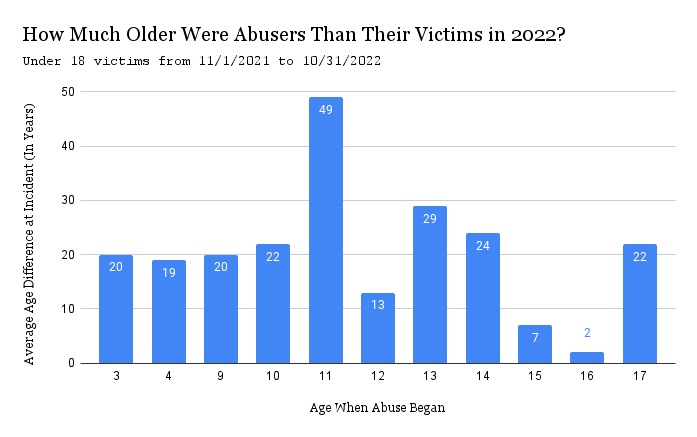
The age of the victims shows the average age difference between the victim and abuser. The data from the charts is from the date of the incident when the victim was abused and using the victim and defendant’s date of birth to determine their age difference at the time of the incident.
The average age difference between abuser and victim compared to the victim’s age when the abuse began shows no significant trend between the two years.
The graphic accounts for multiple victims and abusers in the various age ranges.
In the first year, the visual shows a higher average age difference when victims were six years old and younger when compared to older victims, ages nine through fifteen.
It can be seen that in the first year, the average age difference between victim and abuser is higher than in the second year. There is a much higher age difference for younger victims (ages 3 – 6) who were victimized in the first year compared to victims in the second year. In the second year a large spike in age difference is seen with 11-year-old victims.
The graphic accounts for multiple victims and abusers in the various age ranges.The graphic accounts for multiple victims and abusers in the various age ranges.
The third chart shows age differences for all victims under 18 when incidents occurred from Nov. 1, 2020 to Oct. 31, 2022. Data shows a trend of most of the average age differences between victim and abuser are 22 years and higher.
Data compiled in D.C. Witness’ databases come from cases that have not only first been reported to the MPD, but also ones in which the defendant has been formally charged before a judge in the DC Superior Court. There may be other incidents that have occurred in D.C. during this time period that have not been reported, or incidents where the defendant has not been charged that are not a part of D.C. Witness data.
Metropolitan Police Department detectives are asking for the public’s help in locating a suspect in a homicide that occurred on Dec. 17, on the 2400 block of 18th Street, NW.
According to a press release, at about 1:20 am, officers located 30-year-old Avon Perkins and an adult female suffering from apparent gunshot wounds. Avon Perkins was pronounced dead at the scene.
The adult female was transported to a local hospital for treatment of non-life-threatening injuries.
Metropolitan Police Department detectives are asking for the public’s help in locating a suspect and a vehicle in connection to an assault with intent to kill offense that occurred on Dec. 20, on the 6000 block of Clay Street, NE.
According to a press release, at about 2:54 pm, officers located an adult male victim and a juvenile male suffering from gunshot wounds.
Metropolitan Police Department detectives are asking for the public’s help in locating a vehicle in connection to a non-fatal shooting offense that occurred on Dec. 20, on the 1500 block of Good Hope Road, SE.
According to a press release, at about 2:55 pm, officers located an adult male victim suffering from an apparent gunshot wound.
Metropolitan Police Department detectives are investigating a homicide that occurred on Dec. 20, on the 1500 block of Anacostia Avenue, NE.
According to a press release, at about 9:41 pm, officers located 34-year-old Rynell Bradford suffering from an apparent gunshot wounds. He was pronounced dead at the scene.
As we embark on this holiday season, you may notice that D.C. Witness will be slowing down the number of articles we have online.
Although still working hard behind the scenes, we are adjusting our schedules for the holiday season. However, please keep checking the site as we will continue to provide you with up-to-date information on violent crime in the city.
Metropolitan Police Department detectives are asking for the public’s help in locating a vehicle in connection to a homicide that occurred on Dec. 17, on the 1700 block of Euclid Street, NW.
According to a press release, at about 10:07 pm, officers responded to the location for the report of a person struck by a vehicle. Upon arrival, officers located 18-year-old Derron McQueen suffering from apparent gunshot wounds.
The suspect vehicle is described as a white Chevrolet Volt, with silver rims.
Metropolitan Police Department detectives are investigating a traffic fatality from that occurred on Dec. 17, on the 3200 block of 8th Street, NE.
According to a press release, at about 8:11 pm, an adult female approached the driver of the Mercedes-Benz SUV and the two engaged in a verbal altercation. The adult female then grabbed onto the side view mirror and stood on the running board which led to her falling off of the moving vehicle. The driver stopped and called 911.
The woman was pronounced dead at the scene.
The decedent has been identified as 25-year-old Sheda’sa Thompson.
Metropolitan Police Department detectives made an arrest in a homicide that occurred on August 23, on the 2300 block of Minnesota Avenue, SE.
According to a press release, at about 9:34 pm, officers located 24-year-old Chaquan Barbett suffering from apparent gunshot wounds. He was pronounced dead at the scene.
On Dec. 19, 18-year-old Jerome Israel was arrested and charged with first-degree murder while armed.
Metropolitan Police Department detectives are investigating a homicide that occurred on Dec. 17, on the 1700 block of Euclid Street, NW.
According to a press release, at about 10:07 pm, officers responded to the location for the reports of a person struck by a vehicle. Upon arrival, officers located 18-year-old Derron McQueen suffering from apparent gunshot wounds. He was pronounced dead at a scene.
Metropolitan Police Department detectives made an arrest in connection to a homicide that occurred on Oct. 28, on the 900 block of Bellevue Street, SE.
According to a press release, at about 2:53 am, officers located 38-year-old Maurice Frazier in the hallway of an apartment building, suffering from gunshot wounds. He was pronounced dead at the scene.
On Dec. 16, 34-year-old Myron Hickson was arrested and charged with second-degree murder while armed.
A mistrial was declared in a murder on Dec. 16. Jurors began deliberating on Dec. 13.
Jermaine Harris, 21, is charged with first-degree murder while armed in connection to the death of 38-year-old Lamar Walters on the 2400 block of Franklin Street, NE, on Jan. 6, 2020.
The mistrial followed a request for more guidance in whether they could find Harris guilty of other charges if not first-degree murder.
A status hearing was set for Jan. 10 to discuss how parties will proceed.