A DC Superior Court judge ruled that there is enough evidence to bring a homicide case to trial.
Kenneth Stewart, 59, is charged with first-degree murder while armed for allegedly stabbing 54-year-old Courtney Jones on July 23, 2020, on the 2300 block of Pennsylvania Avenue, SE.
During the March 29 preliminary hearing, a Metropolitan Police Department (MPD) detective on the case testified that multiple witnesses said they saw Stewart stabbing Jones in a van on the side of the road.
According to the detective, witnesses reported that Stewart had been “picking on” Jones throughout the day and they had multiple altercations leading up to the homicide.
During the incident, another passenger in the van hit Stewart over the head with a glass bottle, according to the MPD detective. Witnesses differ on whether this occurred before or after the stabbing.
Defense attorney Dominique Winters questioned the credibility of those witnesses. According to Winters, one witness reported Stewart kicking Jones in a restaurant parking lot earlier in the day, but no other witnesses could confirm it. The MPD could not find any surveillance footage from the restaurant to verify the claim.
The defense argued that the homicide was committed in self-defense.
The prosecution argued that, even if Stewart had to defend himself during the course of the incident, that doesn’t mean the homicide was done in self-defense.
Witnesses say Stewart was harassing Jones all day and threatening to kill him, which the prosecution argued supports the first-degree murder charge.
Judge Neal Kravitz found probable cause for first-degree murder. Even though there may be “significant credibility issues” with some of the witnesses’ stories, there is still sufficient corroboration and any discrepancies would be dealt with at trial, he said.
“There is probable cause to believe that the defendant was the initial aggressor here,” Judge Kravitz said. According to DC law, if someone is the initial aggressor, he is not entitled to use deadly force as self-defense.
Taking into account Stewart’s long criminal history and the violent nature of the case, Judge Kravitz decided to continue holding him at DC Jail in the interest of public safety.
A DC Superior Court judge scheduled a hearing to determine if a sex abuse case has enough evidence to go to trial. She also amended the defendant’s release conditions.
The defendant is charged with second-degree sex abuse and blackmail for allegedly threatening to disclose the victim’s personal information to others if she did not meet with him for sex in 2019.
The defendant has been on pretrial release with GPS monitoring for over a year. Defense attorney Brandi Harden asked for the monitor to be removed because the defendant has been in full compliance with the conditions of his release.
During the March 31 proceeding, Judge Marisa Demeo granted the defense’s motion to remove the GPS and curfew requirements from the defendant’s conditions of release.
However, Judge Demeo ruled that he will remain under the High Intensity Supervision Program (HISP) to continue monitoring his compliance.
Judge Demeo scheduled the preliminary hearing for July 30.
A DC Superior Court judge scheduled a preliminary hearing for a homicide defendant.
Rashon Hall, 25, is charged with first-degree murder while armed for the alleged shooting of 22 year-old Joseph Simmons to death with a firearm on Jan. 3 on the 2800 block of Alabama Ave, SE.
The hearing today is the first status conference since the presentment hearing on March 9 after his arrest on March 8.
A DC Superior Court judge presided over cases for seven domestic violence defendants March 30, releasing them all.
There were a total of 13 cases presented before the judge.
The domestic violence defendants are charged with simple assault, violation of a Civil Protection Order (CPO), contempt and attempted threats to do bodily harm.
Upon release, Judge Heide Herrmann gave each defendant a stay-away order from either the alleged victims, locations of the incident or both.
The prosecution requested that one defendant, who is facing domestic violence charges for a CPO violation and contempt be held at DC Jail due to additional charges that are pending in a separate case for simple assault and attempted second-degree cruelty to children.
Judge Herrmann denied the request, citing the fact that no one was hurt in this new case and that the defendant is only alleged to have violated the stay-away from the location in his pending case.
The judge released the defendant, requiring participation in GPS monitoring by the Pretrial Services Agency (PSA).
The released defendants were ordered to return on Oct. 5.
The Metropolitan Police Department (MPD) sent out one crime alert between 9:00 p.m. on March 30 and 9:00 a.m. on March 31.
The alert was sent at 9:36 p.m. for a robbery on the 900 block of Rhode Island Avenue, NE.
Police are looking for three Black males in hooded sweatshirts. One of the suspects is 5’11” in height with a thin build and armed with a gun. The suspect was last seen headed east towards 10th Street.
A DC Superior Court judge granted an emergency motion for a defendant’s transfer to Saint Elizabeth’s Hospital, DC’s psychiatric institution.
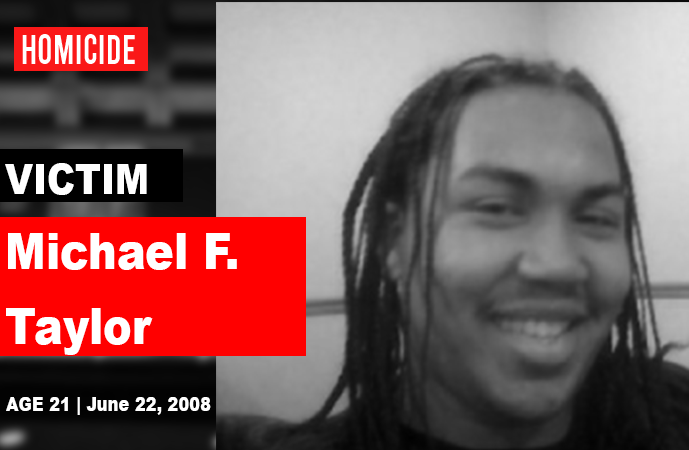
Michael Francis Taylor
In March 2020, Joshua Ellis Massaquoi pleaded guilty to conspiracy to commit murder, carrying a pistol during a crime of violence and accessory to second-degree murder in the death of 21-year-old Michael Francis Taylor on June 22, 2008, on the 600 block of Farragut St, NW.
The 33-year-old defendant was released into home confinement as he waits to be sentenced. However, on March 25, a bench warrant was issued for his arrest. That same day, a medical alert was issued. D.C. Witness is not sure if the two are related.
During the March 30 hearing, Judge Hiram E. Puig-Lugo ordered a preliminary screening to determine Massaquoi’s competency.
The judge granted the defense’s unopposed emergency motion for Massaquoi to be transferred to Saint Elizabeth’s
A mental observation hearing is scheduled for April 8.
In February 2020, a jury found 34-year-old Mason Binion guilty of first-degree murder while armed in Taylor’s death.
John Littlejohn says he’ll never forget the Saturday night he sat on a church’s steps high on PCP.
“The police were making patrols in the neighborhood,” he recalls. “I was a dealer and a user.”
This was the early 1980s, when abuse of this powerful hallucinogen was reportedly rising in cities including DC.
And the drug has not lost its impact on the city’s criminal justice system, as many were reminded in 2015 when a woman in her thirties was fatally struck by a pick-up truck. The driver allegedly tested positive for PCP.
In fact, Commander John Haines of the Metropolitan Police Department’s (MPD) Narcotics and Special Investigations Division (NSID) said it is not uncommon to come across PCP daily in the District when D.C. Witness spoke to him last year.
As for Littlejohn, he went back to that church the next Sunday. And he kept going. And he kept dealing.
“I was asking the priest to help me – stop me from dealing,” he said. “But the habit was so large, I couldn’t get rid of it.”
Littlejohn was eventually arrested for possession of PCP.
The year was 1983. He found himself facing 15 to 30 years in prison. However, the judge gave him two years of probation instead.
Littlejohn says the police saved his life the day they arrested him. He says it was the last day he ever dealt. He has since been able to get sober and have the charge taken off his record.
“I carry my bible, you know?” he said. “I knew the road was going to be long and the road was going to be tough.”
Photo by Maansi Srivastava
But while Littlejohn’s case may have run its course nearly four decades ago, PCP’s presence in DC’s criminal justice system remains despite the fact that, according to national statistics from the Center for Behavioral Health Statistics and Quality (CBHSQ), in 2015 only 2.4 percent of people aged 12 or older have used PCP in their lifetime.
“It’s very unique to DC and a couple other parts of the country,” said Dr. Regina LaBelle, program director of the Addiction and Public Policy Initiative at the O’Neill Institute for National and Global Health Law at Georgetown Law.
PCP, which belongs to the dissociative category of hallucinogens, can cause users to feel disconnected from their environment and even their own bodies, according to a National Institute on Drug Abuse (NIDA) report. It was developed as an anesthetic in the 1950s, only to get discontinued and emerge as a street drug in the 1960s.
PCP in the DC Courts
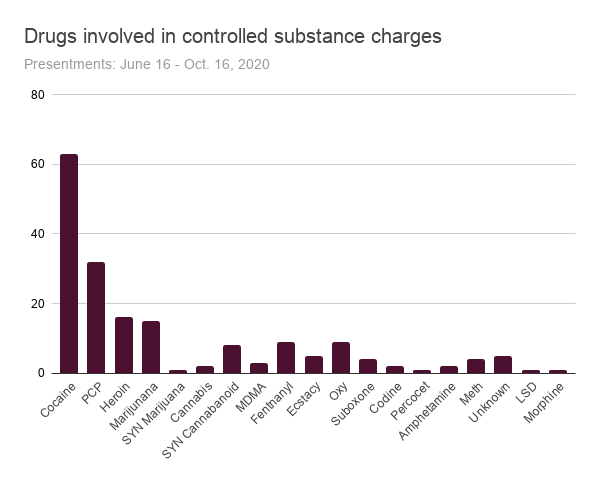
One hundred and seventy-one of the defendants who were brought before judges at the DC Superior Court for initial hearings from June 16 to Oct. 16, 2020, had a controlled substance charge filed against them, according to D.C. Witness data. Thirty-two of them picked up a PCP-involved charge. That’s about 18 percent.
PCP was the second most common drug with which people were charged during this time. Only cocaine showed up more often.
According to D.C. Witness data
Twenty-five of the defendants were charged in felony cases.
Seven were charged in misdemeanor cases. Two of the felony cases – one involving an unlawful possession of liquid PCP charge and the other involving a possession of a controlled substance charge – have been dismissed by prosecutors. Aside from one defendant whose case status D.C. Witness could not verify, the others’ cases remain open.
Some defendants are charged with offenses involving more than one drug
Most of the alleged offenses happened in Ward 6.
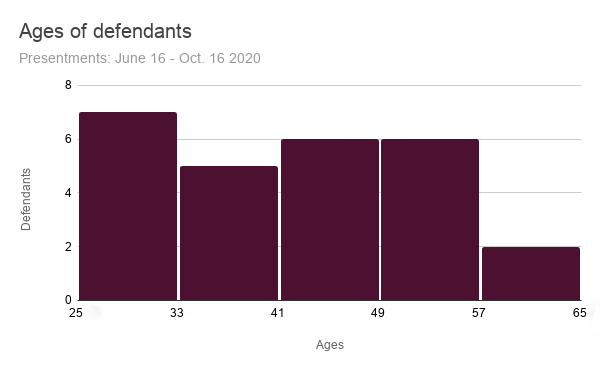
The average age of the defendants was 41 years-old. Their ages ranged from 28 years-old to 64 years-old, data shows. This is excluding six defendants, whose dates of birth could not be found.
“It seems that a lot of these drugs are recycled from one generation to the next,” said Dr. Edwin Chapman, who has spent over four decades practicing in DC with a specialization in internal medicine and addiction medicine. “They may appear for a time, and then, for some reason, become out of vogue, and then show up again.”
There are several types of charges related to controlled substances, and some of these defendants were charged with more than one of them related to PCP.
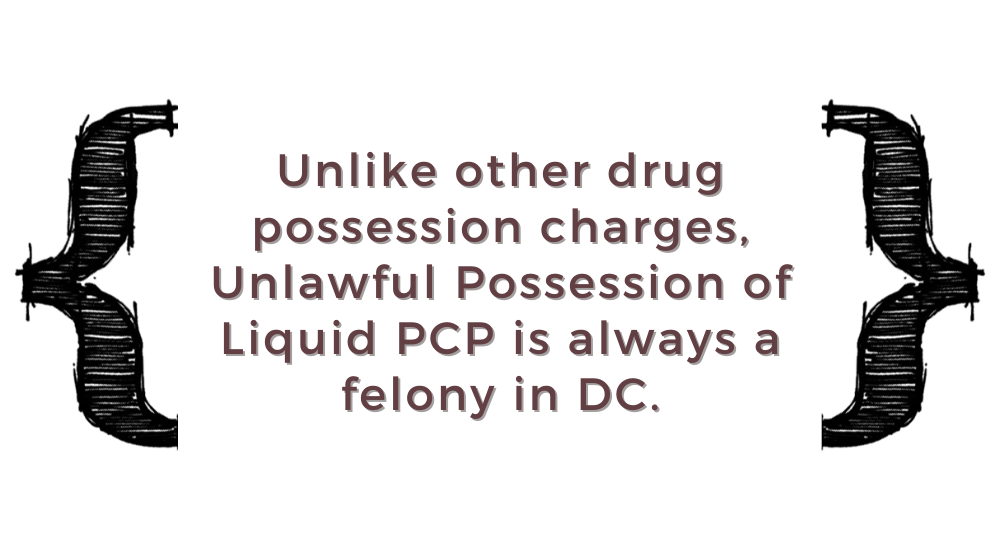
The most common PCP charge in these cases was unlawful possession of liquid PCP. Over half of the defendants picked it up. The charge is a felony in DC and has been since 2010.
“This was legislation enacted by the DC City Council in efforts to stop the flow and use of liquid PCP in the city,” said Commander Haines.
From June 16 – Oct. 16, 2020, eight defendants were charged with possession of a controlled substance. Nine were charged with either possession with intent to distribute or distribution of a controlled substance.
“We do see PCP, particularly among the homeless population,” said Dr. Chapman. “It’s cheap. I think that’s probably the key component, the fact that it’s a relatively cheap buy.”
A 2001 study from the National Drug Intelligence Center estimated a PCP-laced cigarette or joint to cost around $5-$30. The study estimated that a gram of powder or single tablet costs between $20-$30. Finally, the study estimated the drug to cost $125-$600 per ounce in liquid form.
According to D.C. Witness research, one of the 32 defendants was listed as having no fixed address in court documents. Another defendant’s court document had nothing listed for his address.
But even if a defendant is not charged with a drug offense, allegations of drug use may still be relevant to their case.
That 2015 homicide case opened when Robert Paris was charged with second-degree murder while armed for allegedly striking and killing 32-year-old Tomika Early with his pick-up truck while she was changing a flat tire at the intersection of Suitland Parkway and Stanton Road, SE on July 14.
Paris pleaded out on charges of voluntary manslaughter and driving under the influence. He was sentenced to serve 10 years for the manslaughter charge plus five months for the DUI.
During his sentencing hearing, an apologetic Paris said he would take Early’s place if he could, The Washington Post reported.
“Because of the behaviors associated with PCP, they [users] definitely have a tendency to end up in the criminal justice system,” said Dr. Chapman.
Sean Thompson-El, a rehabilitation specialist at mental health nonprofit Community Connections, Inc., has seen a lot of PCP throughout his career.
“It just amazed me because that drug is just too strong and too dangerous that people still experiment with it,” he said.
Symptoms of short-term use can include delusions and hallucinations, according to a 2016 Surgeon General report. Consequences of long-term use can include problems with speech, thinking and memory. The drug has also been linked to self-injury.
“Large doses may cause you to be very suspicious and not trust others,” an article published by the U.S. National Library of Medicine states. “You might even hear voices that are not there. As a result, you may act strangely or become aggressive and violent.”
The report states that “only a tiny fraction (just over 1 percent) of the incarcerations associated with substance use disorder (SUD) in the 4,602 cases analyzed by CCE received SUD services before, during, and after incarceration.”
The report also found that it took an average of 33 days to connect people, who have been arrested for substance abuse crimes, to treatment options once they were released.
A report by the U.S. Department of Health and Human Services stated, during 2015 – 2017, 11.7 percent of people aged 12 and older in DC had an SUD in the past year, which is higher than the national average of 7.5 percent.
Some people who find themselves in trouble with the law may have alternative options available to them, including the Superior Court Drug Intervention Program. It’s more commonly known as drug court.
Defendants with PCP-involved cases from mid-June to mid-October have not received sentences, and two case have been dismissed, according to D.C. Witness data.
“The problem is that when you see various drugs showing up – like PCP, or amphetamines, or cocaine or opioids – you’re really dealing with an underlying community problem that has to do with anxiety and depression,” Dr. Chapman said. “And that anxiety and depression seems to correlate with economic depression. So I look at these drugs, not necessarily as individual drugs but as a symptom of something larger that’s going on in the community.”
Andrea Keckley and Maansi Srivastava wrote this article.
A DC Superior Court judge released a felony domestic violence defendant after he accepted a global plea offer.
Shaqques Johnson was originally charged with assault with a dangerous weapon and armed kidnapping for barricading a person in an apartment with an axe. He pleaded down to a charge of attempted assault with a dangerous weapon and was sentenced to 15 months, all but five of which were suspended. He was also sentenced to 15 days for simple assault and 30 days for assault on a police officer in two misdemeanor cases.
Because he spent about seven months at DC Jail as a pretrial detainee and is receiving credit for time served, Johnson has already completed his sentence.
During the March 30 sentencing hearing, the prosecution acknowledged Johnson’s mental health and alcohol abuse issues. However, the prosecution is concerned that he is a flight risk and danger to the community due to his prior criminal history.
The prosecution also said they do not feel Johnson can be trusted to engage in treatment programs and felt a longer period of incarceration would be appropriate, along with treatment recommended by the Court Services and Offender Supervision Agency (CSOSA.).
Johnson’s defense attorney, Teresa Kleiman, said Johnson has accepted blame multiple times and has been sober for the seven months he has spent incarcerated. She also said the victim had called her three times of their own volition to express that they wanted Johnson to receive treatment and were not pushing for incarceration.
Judge Juliet McKenna said she does not believe that ordering Johnson to serve more time would be beneficial. She did issue a stay away/no contact order.
Judge McKenna also denied the defense’s request to sentence Johnson under the Youth Rehabilitation Act (YRA), which would have effectively sealed his case after he completes his requirements.
Conditions of Johnson’s probation include: completion of a mental health evaluation and following through with any treatment, enrollment and completion of an anger management course as recommended. Johnson also should undergo alcohol and drug testing as recommended by CSOSA.
As part of the global plea offer, one of Johnson’s misdemeanor cases was dismissed.
On March 29, a DC Superior Court judge released four of the 10 defendants charged in domestic violence cases.
Of the total 31 cases, Judge Heide Herrmann heard 10 domestic violence cases and one sexual abuse case.
One of the defendants, who was held, is charged with contempt for violating his conditions of release and attempted threats to do bodily harm. The defendant has other domestic violence cases with prior stay-away orders.
Judge Herrmann recognized the defendant’s attempts to have a police officer escort him to get property from the location of the stay-away, however, the defendant allegedly made threats to the complainant, which made her believe that he is potentially dangerous to the community.
Another defendant that was held is charged with simple assault and possession of a controlled substance. Judge Herrmann also deemed this defendant potentially dangerous to the community because the domestic violence case also had gun violence associated with it and his prior convictions involving firearms.
Another defendant, who was held, is charged with unlawful entry of private property, second-degree theft and simple assault. The defense attorney asked for the defendant to be placed on home confinement instead of being held at the jail because he has complied with a lot of his release requirements in the past.
However, Judge Herrmann granted the prosecution’s request to hold the defendant.
All three of the defendants are held until their next hearings on April 13.
Judge Herrmann also issued stay-away orders for all remaining domestic violence defendants and ordered them to contact the Pretrial Services Agency (PSA) once a week.
The defendants have charges that include simple assault, attempted threats to do bodily harm, contempt, attempted possession of a prohibited weapon, destruction of property and violation of a Temporary Protection Order (TPO). Additionally, one of the defendants was brought in on a bench warrant for failing to appear at her hearing.
The defendant charged with second-degree sexual abuse was also issued a stay-away order and was instructed to contact PSA once a week as conditions of his release.
The released defendants are scheduled to return to court on Aug. 30.
A domestic violence defendant pleaded guilty to two charges.
According to a proffer of facts, 21-year-old Jestyn Young confronted the victim in her car and, when she tried to call the police, stabbed and slapped her before fleeing the scene.
During the March 26 hearing, Young pleaded down from his initial charge of assault with a dangerous weapon to attempted assault with a dangerous weapon. He also pleaded guilty to contempt.
Young will remain held at DC Jail until he is sentenced on May 27.
DC Superior Court Judge James Crowell ordered a Youth Rehabilitation Act (YRA) study for him. If Young does get sentenced under the YRA, his case will effectively be sealed after he completes certain requirements.
Counsel in a homicide case agreed to wait and see if more courtrooms were available for trials upon reconvening later in the year, rather than schedule one for March 2023.
Rakeem Willis, 29, is charged with first-degree murder while armed in the deaths of 24-year-old Tyrik Hagood, 26-year-old Javon Abney, and 26-year-old Sean Shuler. On Jan. 26, 2019, the three victims were found on the 1500 block of Fort Davis Place, SE suffering from multiple gunshot wounds. All three were pronounced dead on scene.
Willis’ co-defendant, 31-year-old Jonathan Winston, is also charged with first-degree murder while armed for his alleged involvement in the shootings.
During the March 29 hearing, Judge Danya Dayson said that, based on courtroom availability, parties would be looking at a trial date two years from now. She explained that the trial could be set for 2023 or they could come back in August to set a trial.
Judge Dayson said she hopes that more courtrooms will have opened by fall.
Judge Dayson also said the court has been keeping a list of the trials as they have been scheduled so that when more courtrooms become available, those trials could potentially be rescheduled for an earlier date.